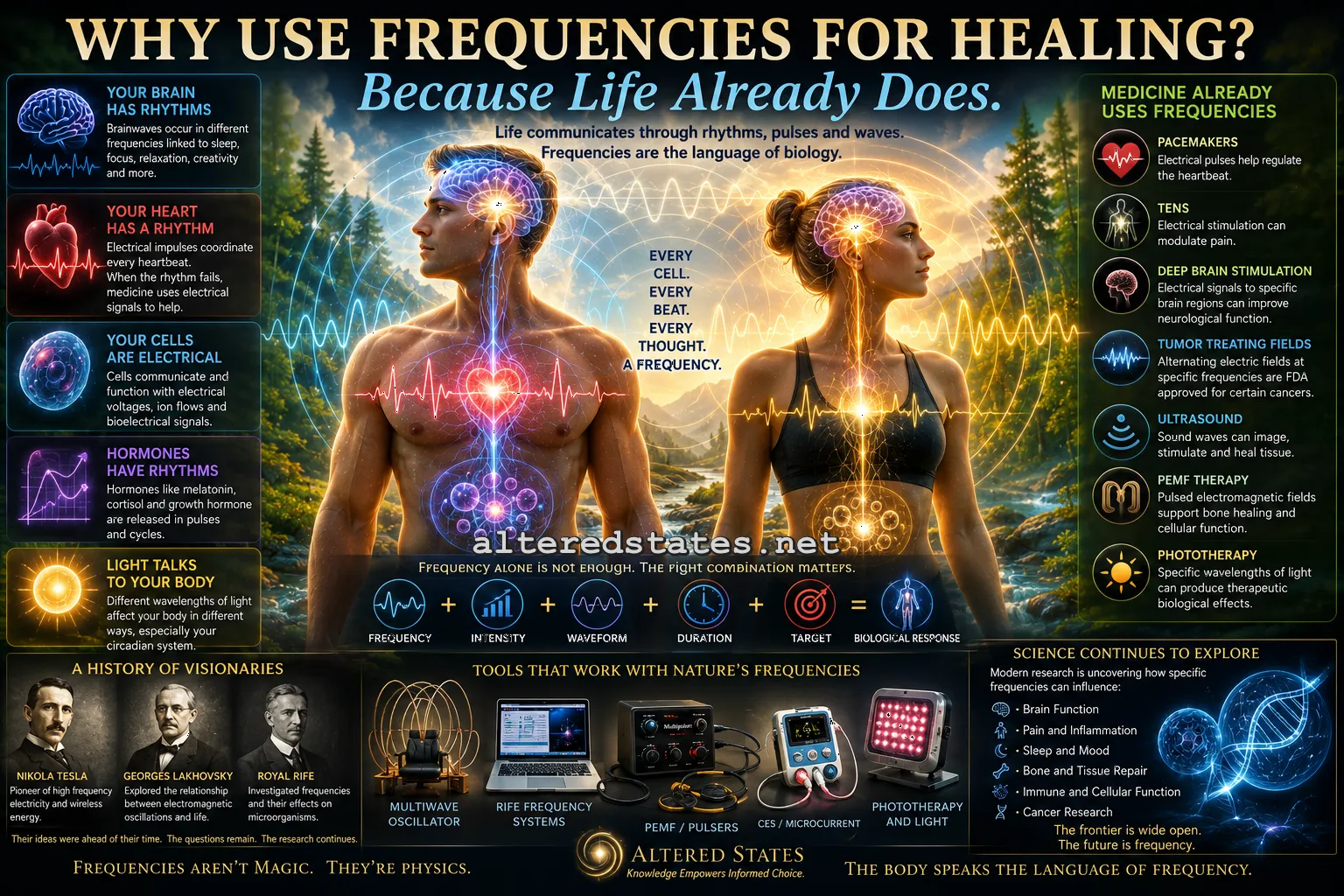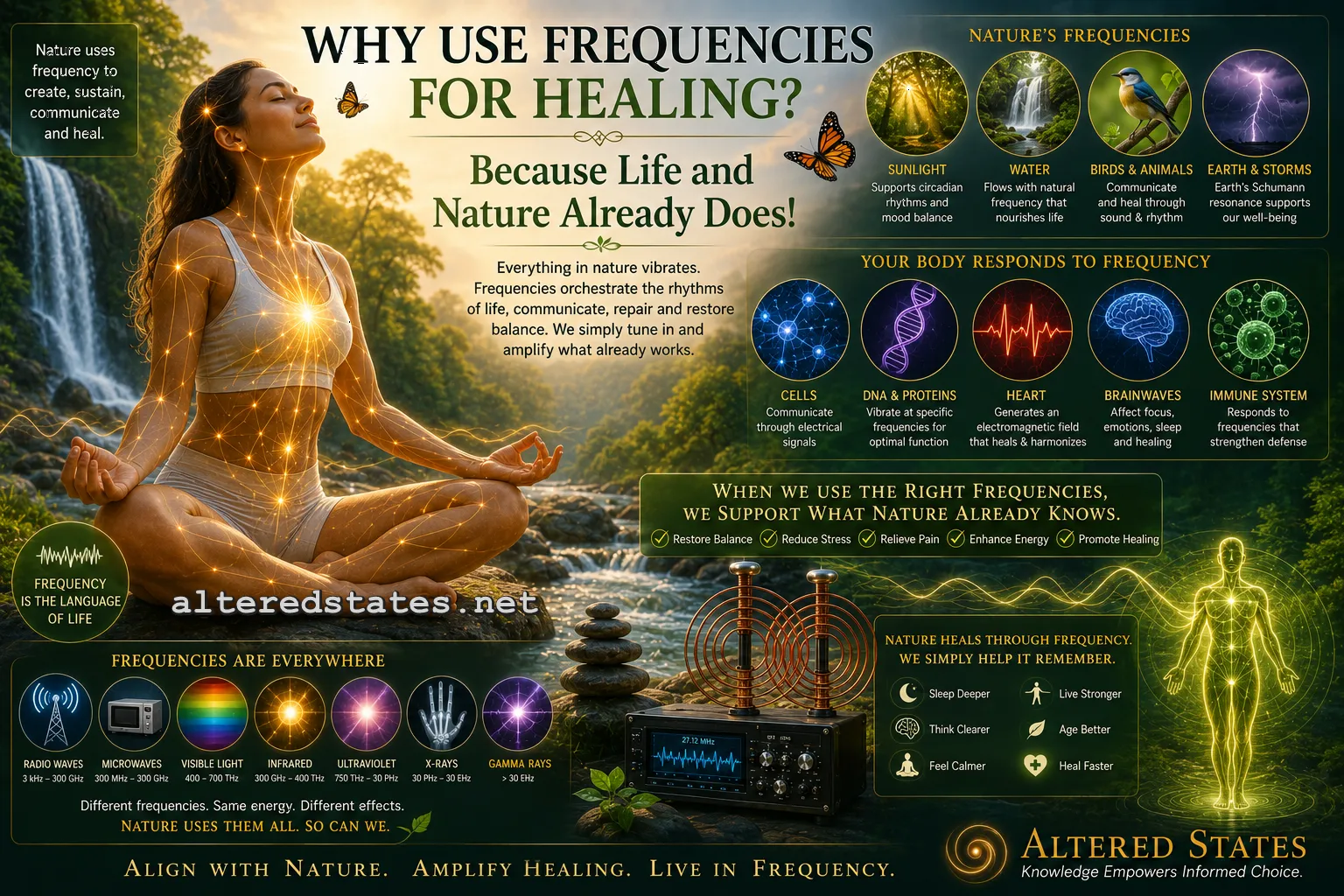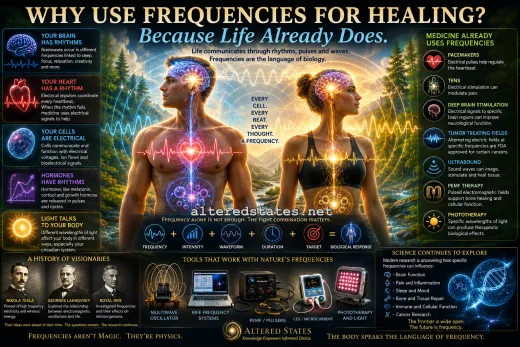
⚡ WHY
USE FREQUENCIES FOR HEALING?
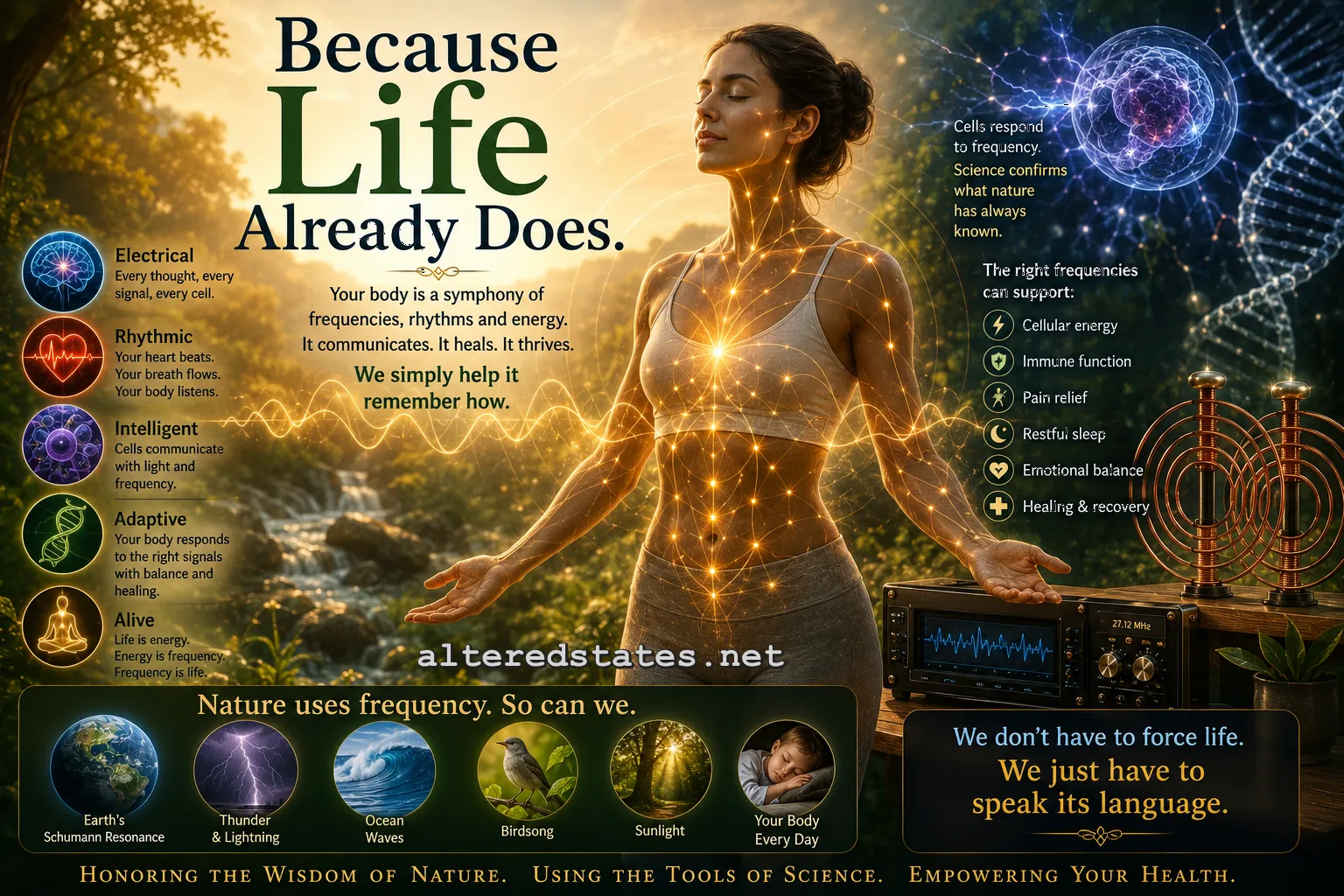
Because
Life Already Does.
When most of us hear the word frequency, we may think of radio, sound,
electricity or perhaps something rather mysterious.
But frequency isn't mysterious.
Frequency simply describes repetition — how often something oscillates, pulses
or cycles.
And when we look closely at the human body, something fascinating becomes apparent:
Life is full of rhythms, pulses, electrical signals and responses to different
frequencies of energy.
Your brain oscillates.
Your heart beats electrically.
Hormones pulse.
Cells maintain electrical voltages.
Your eyes distinguish different wavelengths of electromagnetic radiation.
Sound waves interact with tissue.
And modern medicine already uses electrical, magnetic, acoustic and electromagnetic
energy therapeutically.
So perhaps the question shouldn't simply be:
❓ “Why would anyone investigate frequencies for healing?”
Perhaps we should also ask:
Why wouldn't we?
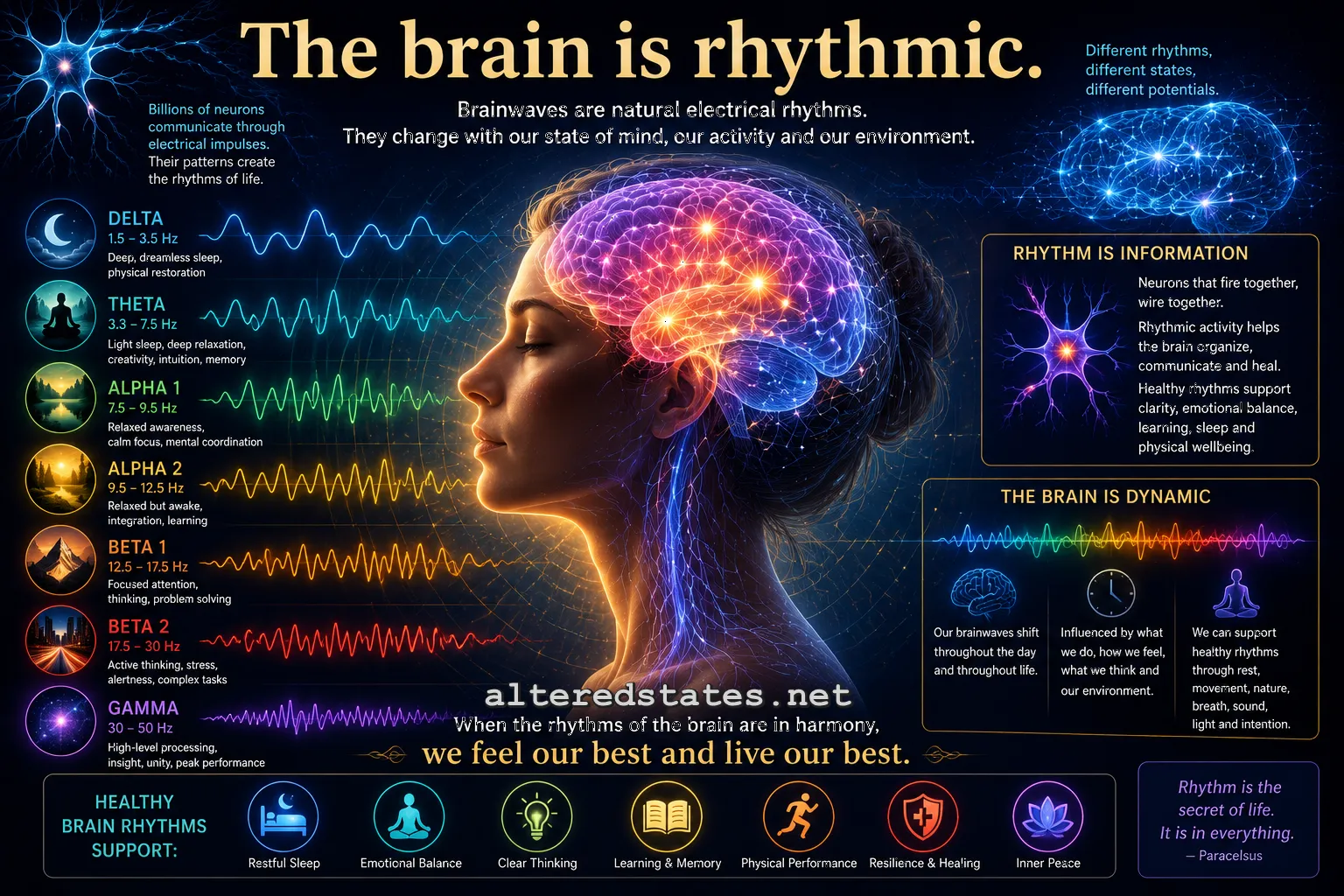
🧠 YOUR BRAIN ALREADY USES FREQUENCIES
One of the clearest examples comes from the human brain.
Electrical activity measured by EEG contains recognizable oscillatory frequency
bands:
🌙 Delta: approximately 1.5–3.5 Hz
🧘 Theta: approximately 3.3–7.5 Hz
😌 Alpha 1: approximately 7.5–9.5 Hz
🌿 Alpha 2: approximately 9.5–12.5 Hz
🎯 Beta 1: approximately 12.5–17.5 Hz
⚡ Beta 2: approximately 17.5–30 Hz
✨ Gamma: approximately 30–50 Hz
These aren't invented therapeutic frequencies.
They are measurable patterns of electrical activity occurring in the living
human brain.
Different oscillations have been associated with different states and processes
involving sleep, attention, sensory processing, cognition
and relaxation.
The precise boundaries vary somewhat between researchers—which itself teaches
us an important lesson:
Biology rarely fits perfectly into little boxes.
Nevertheless, the fundamental observation remains.
The brain is rhythmic.
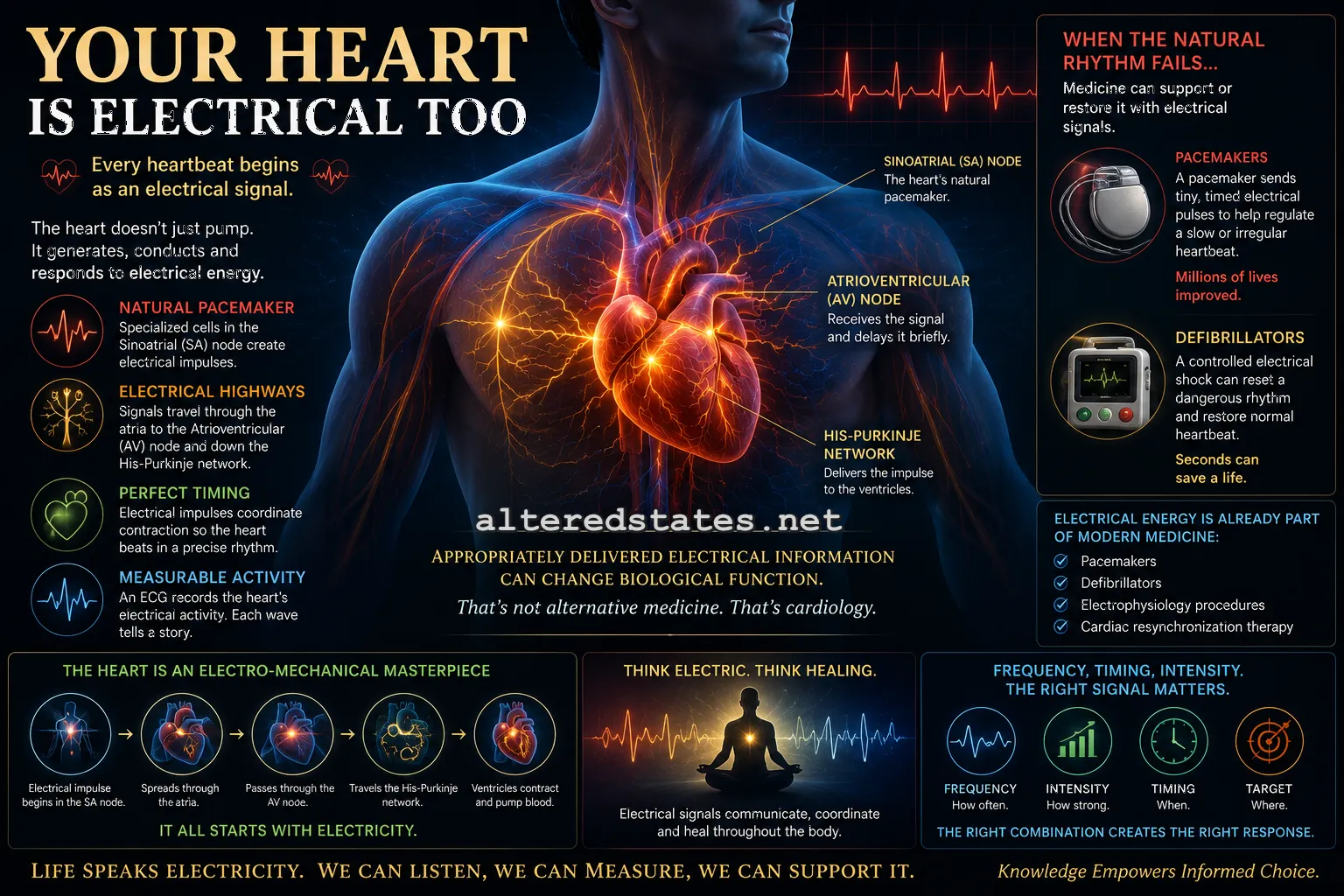
❤️ YOUR HEART IS ELECTRICAL TOO
Place electrodes on the body and we can measure the electrical activity associated
with every heartbeat.
That is what an ECG does.
Specialized pacemaker cells generate electrical impulses.
Those signals travel through the heart's conduction system and coordinate contraction.
And when this natural electrical timing system fails?
Medicine doesn't always reach for another chemical.
Sometimes it supplies:
⚡ AN ELECTRICAL SIGNAL
A cardiac pacemaker delivers precisely timed electrical pulses to help regulate
the heartbeat.
Think about what that means.
Appropriately delivered electrical information can change biological function.
That isn't alternative medicine.
It is everyday cardiology.
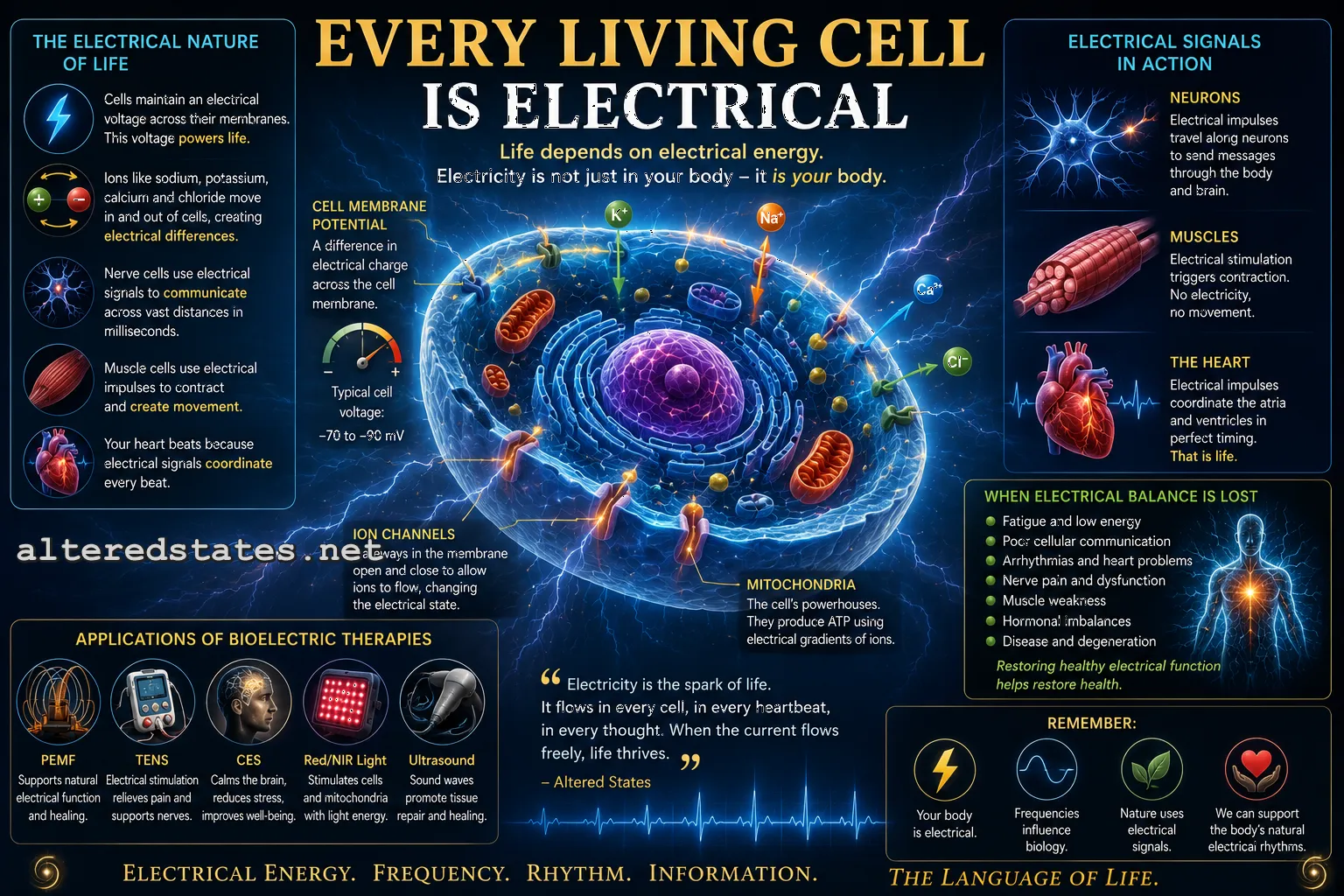
⚡ EVERY LIVING CELL IS ELECTRICAL
Go smaller still.
Every living cell maintains an electrical difference across its membrane.
Charged particles—ions such as:
Sodium • Potassium • Calcium • Chloride
are distributed differently inside and outside cells.
Specialized channels and pumps regulate their movement.
This creates what scientists call the:
MEMBRANE POTENTIAL
Neurons exploit rapidly changing membrane potentials to transmit information.
Muscle cells use electrical excitation as part of contraction.
Calcium ions act as extraordinarily important intracellular signals.
So chemistry and electricity aren't two completely separate worlds.
Living chemistry operates in an electrical environment.
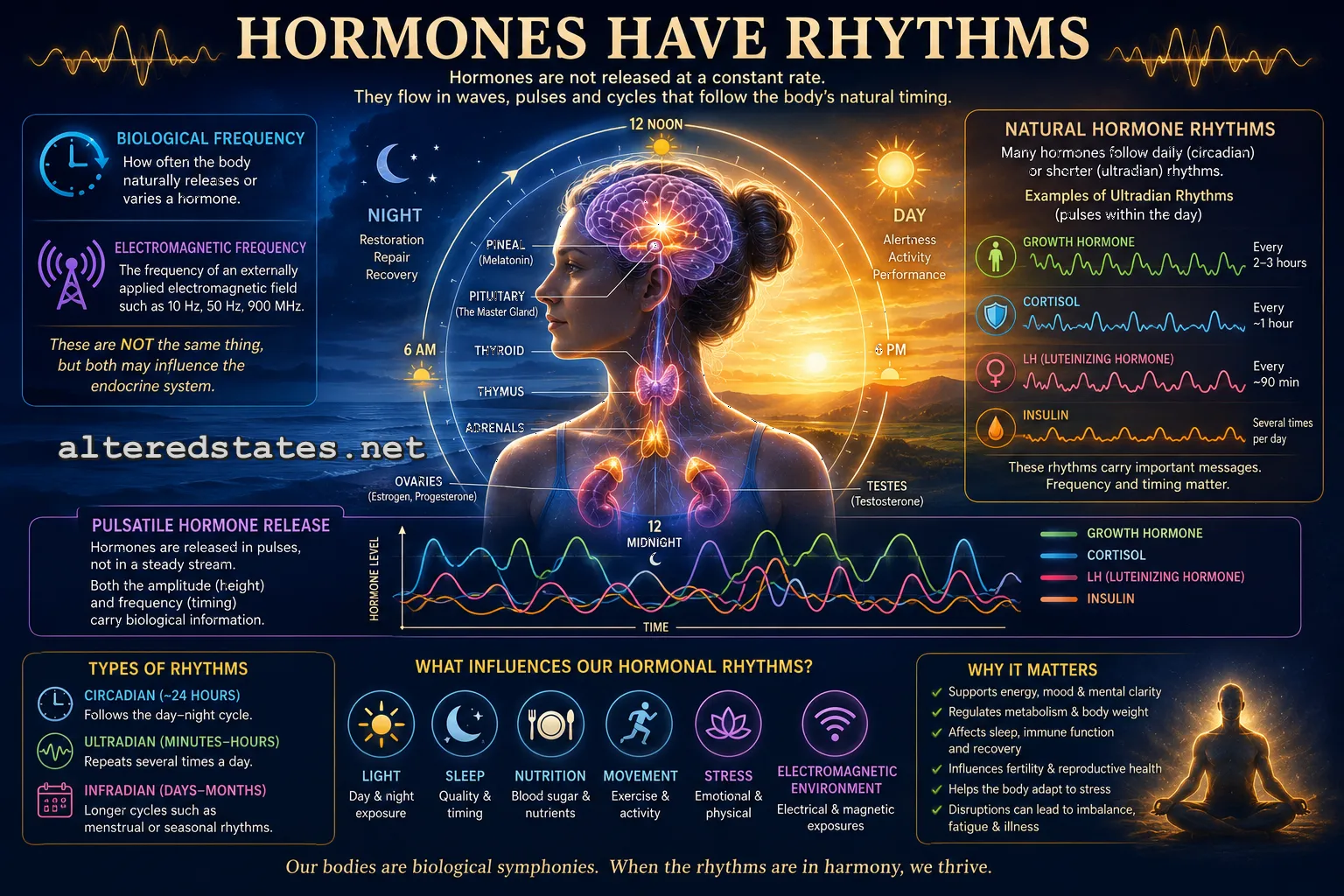
🌊 HORMONES HAVE RHYTHMS
This becomes even more fascinating when we look at the endocrine system.
We tend to imagine hormones as chemicals simply flowing continuously through
our bloodstream.
But many aren't released continuously.
They are released in pulses.
Researchers describe both:
🕐 Circadian rhythms — approximately 24-hour cycles
and
〰️ Ultradian rhythms — repeating cycles
shorter than 24 hours.
Growth hormone provides a beautiful example.
Studies measuring GH every 20 minutes have identified roughly 12 significant
GH peaks per 24 hours, with an average interval
of around 116 minutes in one study population.
Cortisol also has pronounced pulsatility superimposed upon
its daily circadian rhythm, with bursts commonly occurring
approximately every 60–90 minutes.
And sleep research has found fascinating temporal relationships between hormone
pulses and brain activity.
Pulses of growth hormone and prolactin have
been positively associated with increases in EEG delta
activity, while TSH and cortisol show different temporal relationships with
delta activity.
So biological information isn't necessarily contained only in:
HOW MUCH?
It may also involve:
WHEN?
HOW OFTEN?
FOR
HOW LONG?
IN
WHAT PATTERN?
In biology, timing matters.
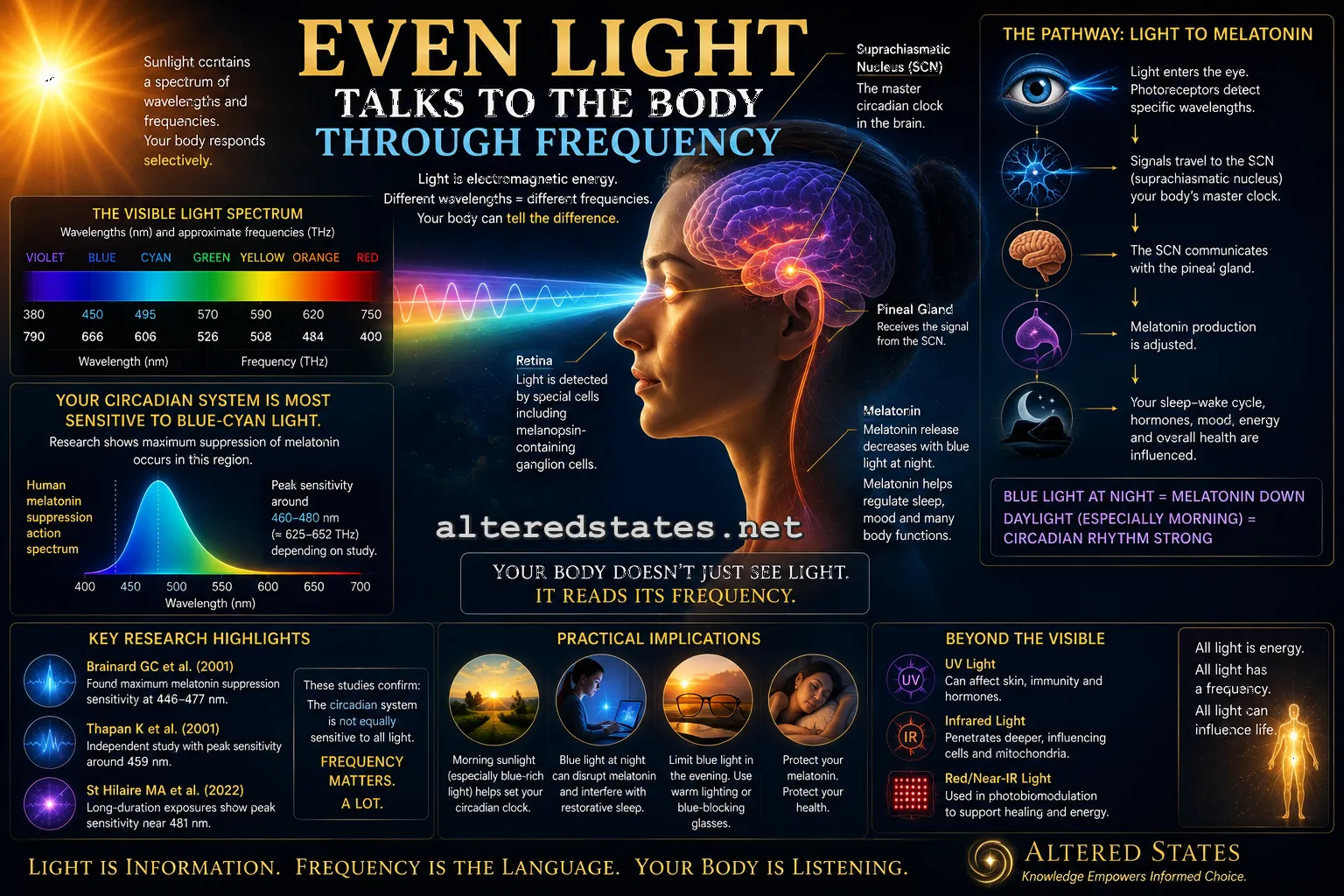
☀️ EVEN LIGHT TALKS TO THE BODY THROUGH FREQUENCY
Here is one of the most remarkable demonstrations.
Visible light is electromagnetic radiation.
Different colours correspond to different wavelengths—and therefore different
electromagnetic frequencies.
The human circadian system doesn't respond equally to every wavelength.
Researchers exposed human volunteers to monochromatic light between 420
and 600 nm and measured nighttime melatonin.
They found the region around 446–477 nm was particularly potent for
regulating/suppressing melatonin secretion.
Another independent human action-spectrum experiment found maximum sensitivity
around 459 nm.
More recent long-duration experiments found an action-spectrum peak around 481
nm, consistent with the important role of melanopsin-containing
retinal ganglion cells in circadian photoreception.
Think about that for a moment.
👁️ Your eyes aren't simply detecting
whether light exists.
The biological response depends partly upon its:
WAVELENGTH — AND
THEREFORE ITS FREQUENCY.
Light enters the eye.
Retinal photoreceptors respond.
Signals reach the brain's circadian clock.
The neuroendocrine system responds.
Melatonin changes.
Sleep and wake timing are influenced.
Electromagnetic energy has become biological information.
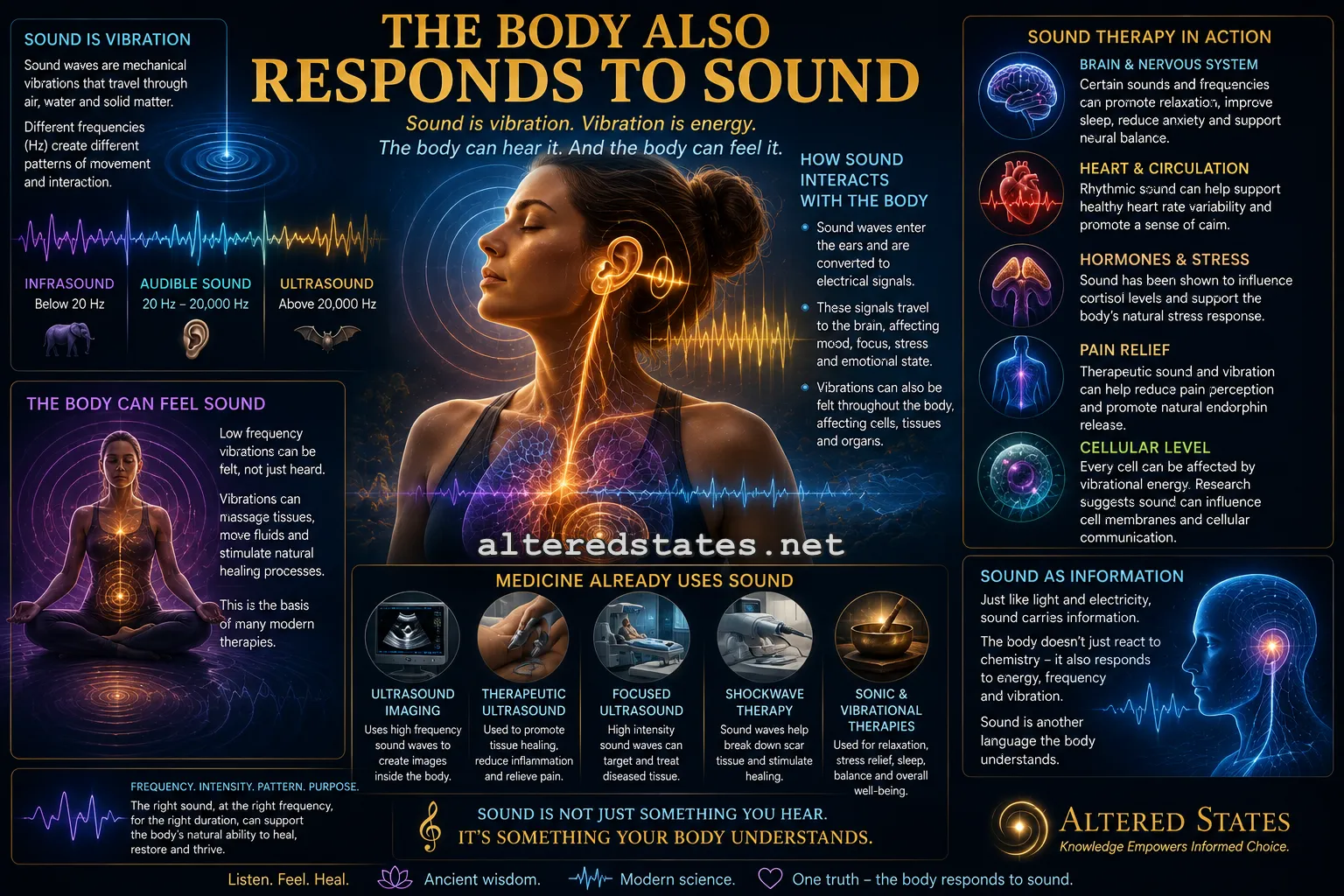
🔊 THE BODY ALSO RESPONDS TO SOUND
Sound is another form of oscillatory energy.
Different frequencies produce different physical interactions with matter.
Medicine has exploited this for decades.
Ultrasound can be used diagnostically to create images inside the body.
But ultrasound energy can also be used therapeutically.
At much higher intensities and with careful focusing, acoustic energy can be
concentrated within tissue.
Again the principle is important:
Energy can interact with biology without being a chemical drug.
🧲 MEDICINE ALREADY USES ELECTROMAGNETIC AND ELECTRICAL SIGNALS
This is where the distinction between frequency medicine and ordinary
medicine begins to become less obvious.
Modern healthcare already contains numerous examples of therapies based upon
energy and electrical signalling.
❤️ PACEMAKERS
Timed electrical impulses influence cardiac activity.
⚡ TENS
Transcutaneous Electrical Nerve Stimulation sends electrical impulses through electrodes
placed on the skin and has been investigated extensively
for pain modulation. Evidence varies according to condition
and application, which is another reminder that electrical
stimulation isn't automatically effective simply because
electricity is involved.
🧠 DEEP BRAIN STIMULATION
DBS uses implanted electrodes to deliver electrical signals into selected brain
regions.
It is used clinically for conditions including Parkinson's disease, essential
tremor and dystonia, and
has also been approved for certain epilepsy applications.
Read that again:
Electrical stimulation of the brain can alter neurological function sufficiently
to become an established medical treatment.
🧠 THEN THERE ARE TUMOR TREATING FIELDS
Perhaps one of the most extraordinary modern examples is:
TUMOR TREATING FIELDS — TTFields
These are alternating electric fields applied to tumors.
The FDA documentation for Optune describes intermediate-frequency
fields on the order of approximately:
100–300 kHz
and specifies 200 kHz for glioblastoma.
The fields interfere with processes involved in rapidly dividing tumor cells.
Optune is an FDA-approved treatment for particular patients with glioblastoma.
That gives us an extremely important distinction.
It doesn't prove that arbitrary frequency treatments cure cancer.
It demonstrates something much more specific:
Carefully selected alternating electric-field parameters can produce biologically
useful effects and have become part of conventional
cancer treatment.
The Hoyland System in the Rife pro allows you to experiment with TTF frequencies
🤔 SO WHEN DID “FREQUENCY” BECOME UNUSUAL?
Perhaps it never was.
Frequency itself isn't alternative medicine.
Frequency is physics.
What determines whether a frequency treatment becomes credible medicine is
something entirely different:
🔬 Can the effect be measured?
🔁 Can it be reproduced?
👥 Does it work in people?
📊 Is it better than placebo or appropriate
controls?
⚖️ What are its benefits and risks?
🎯 What biological mechanism is involved?
Those are scientific questions.
And they're exactly the questions we should ask.
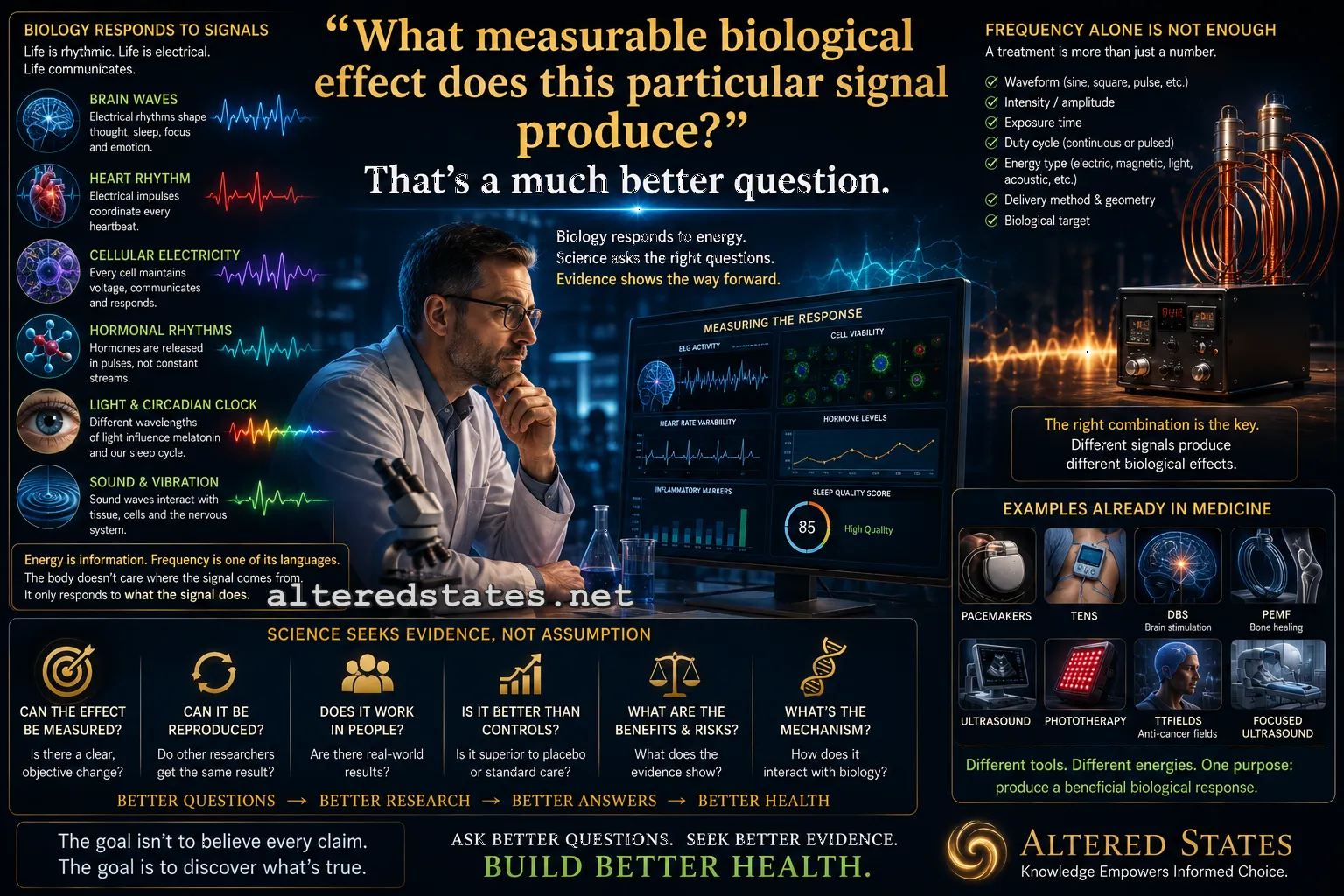
⚡ FREQUENCY ALONE IS NOT ENOUGH
This may be one of the most important lessons in frequency research.
Suppose somebody tells you:
“This treatment uses 20 Hz.”
That actually tells you remarkably little.
We also need to know:
〰️ Waveform — sine,
square, pulse or something more complex?
⚡ Amplitude / intensity — how strong is the
field?
⏱️ Exposure time — seconds, minutes or hours?
🔄 Duty cycle — continuous or intermittent?
🧲 Energy type — electric, magnetic,
electromagnetic, acoustic or mechanical?
📍 Delivery geometry — where and how is it applied?
All
this information is Supplied in our Rife packages
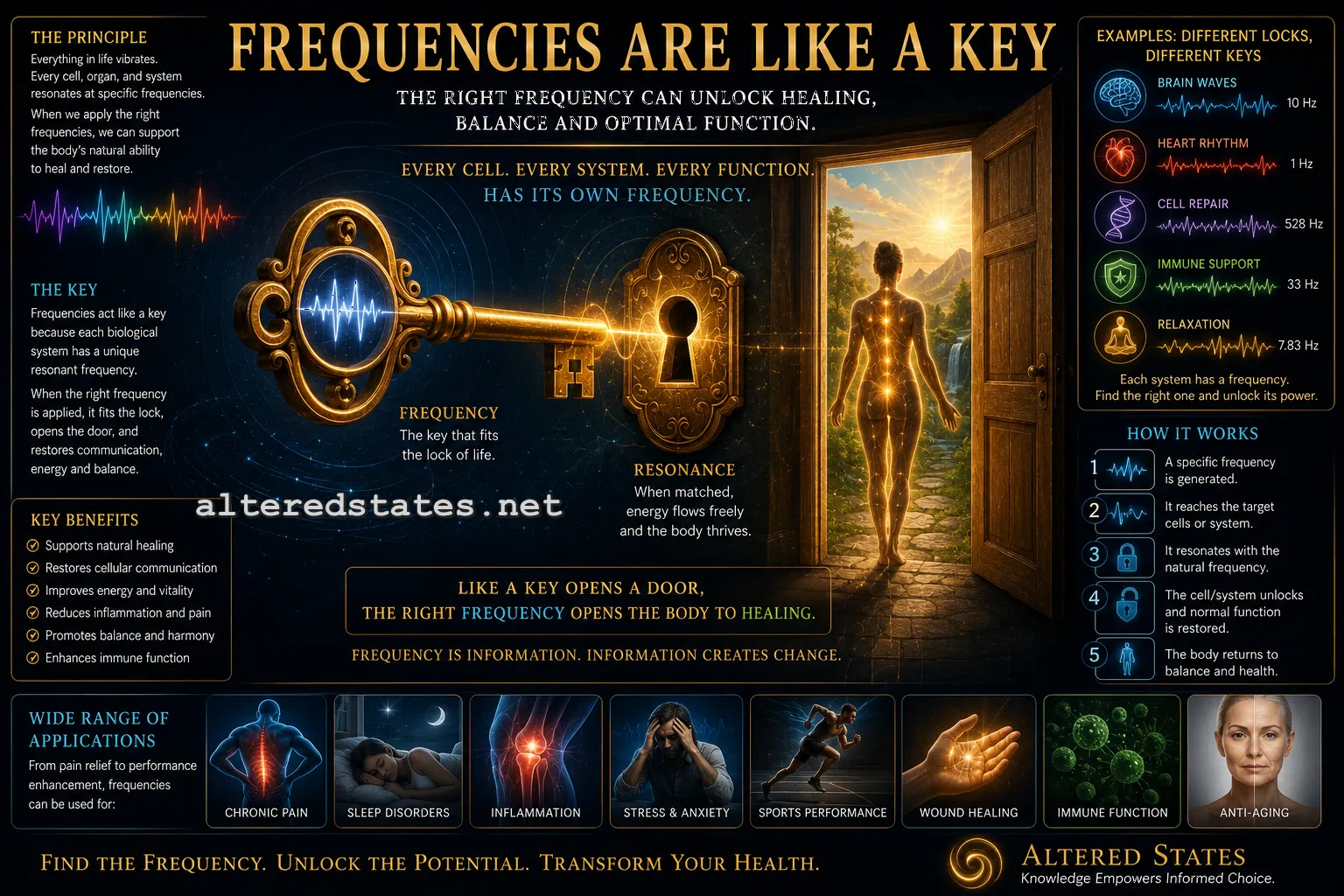
🔑 THINK OF IT LIKE A KEY
Imagine a biological response as a lock.
Frequency might
form one groove in the key.
Intensity another.
Waveform another.
Timing another.
Duration another.
Biological target determines which lock you're attempting to open.
🧠 THE BODY DOESN'T KNOW THE WORD “ALTERNATIVE”
A cell doesn't know whether an electromagnetic field came from a university
laboratory, hospital or someone's workshop.
A neuron doesn't know whether an electrical pulse is considered conventional
or alternative.
A photon doesn't carry a medical philosophy.
A magnetic field doesn't belong to a particular school of medicine.
Biology simply responds—or doesn't respond—according to physics, chemistry
and physiology.
So rather than asking:
“Is frequency medicine alternative?”
perhaps science should ask:
“What measurable biological effect does this particular signal produce?”
That's a much better question.
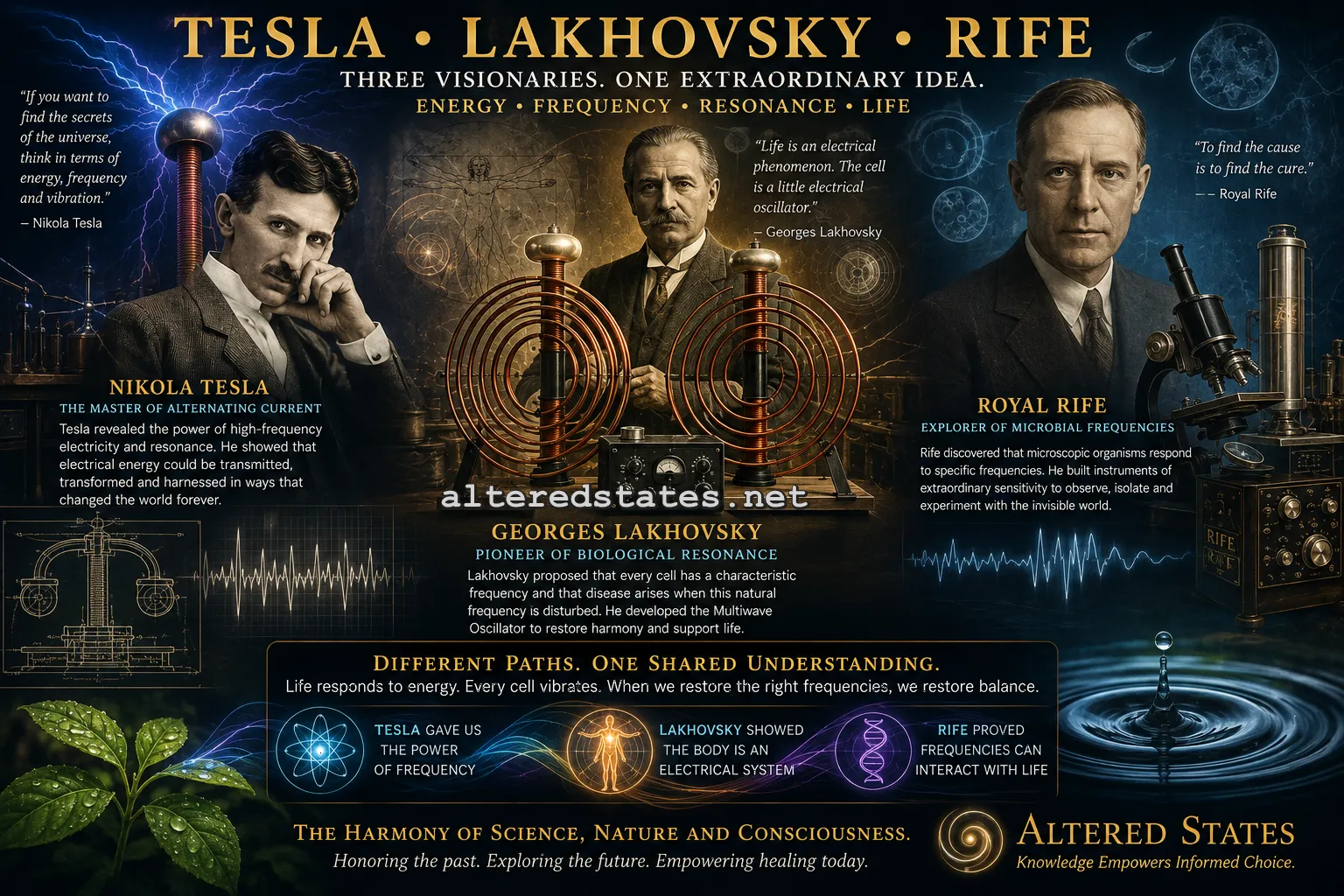
⚡ TESLA • LAKHOVSKY • RIFE
Long before today's sophisticated biomedical equipment, pioneers were already
fascinated by electricity, oscillation and living systems.
⚡ NIKOLA TESLA
Tesla's work revolutionized our understanding and practical use of alternating
currents, high-frequency electricity and resonant electrical
systems.
🌊 GEORGES LAKHOVSKY
Lakhovsky proposed that living cells possessed oscillatory characteristics and experimented
with electromagnetic systems, eventually developing
his Multiwave Oscillator.
Some of his biological theories remain outside established modern medicine.
But the underlying question was fascinating:
Can electromagnetic energy interact meaningfully with living systems?
🔬 ROYAL RIFE
Rife likewise explored relationships between frequencies and microorganisms
and disease.
Yet again, beneath the controversy lies a scientific question that never disappeared:
Can particular physical signals affect particular biological systems differently?
Modern laboratories continue asking versions of that question—with vastly more
sophisticated instrumentation.
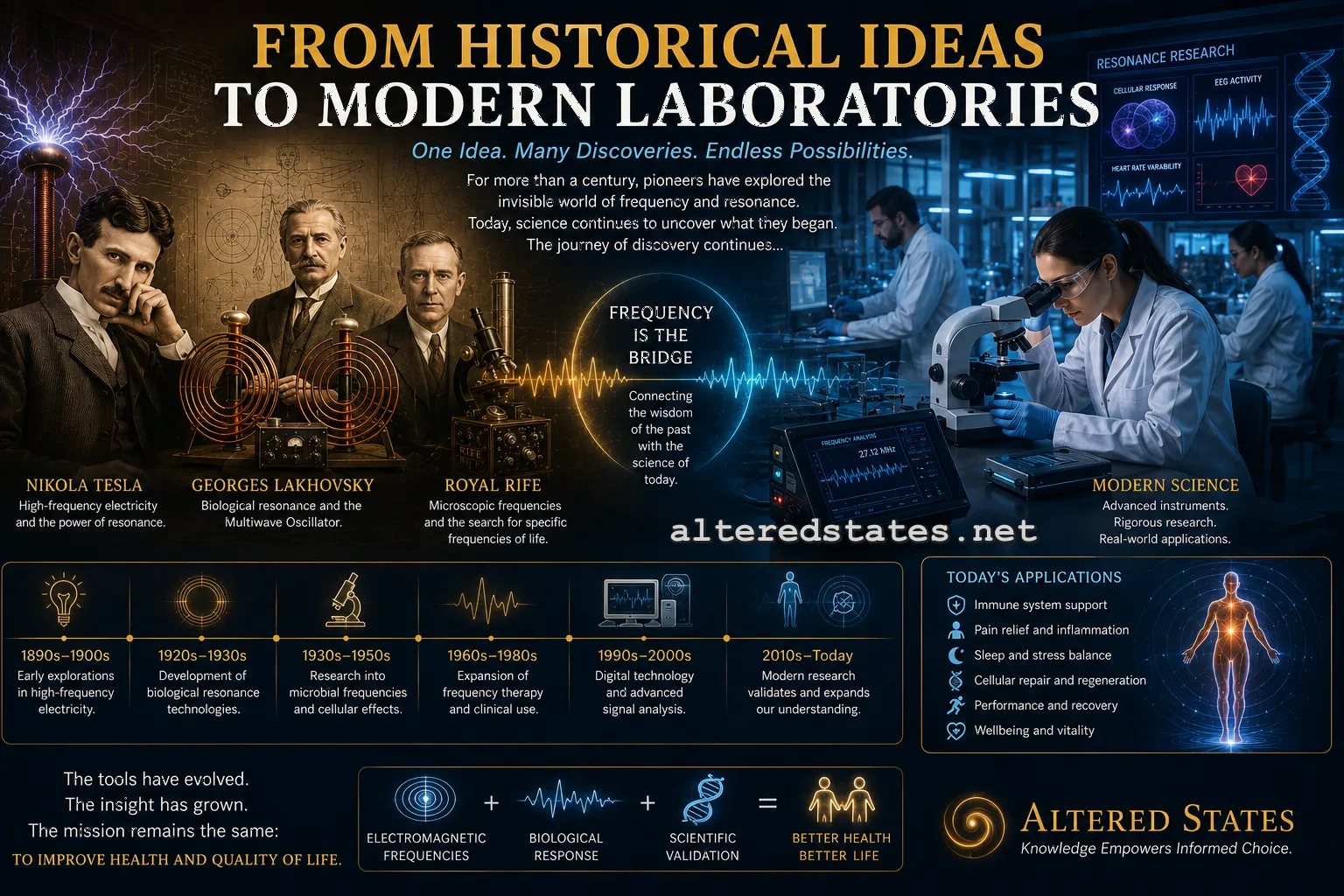
🔬 FROM HISTORICAL IDEAS TO MODERN LABORATORIES
Today's researchers aren't required to accept Tesla's, Lakhovsky's or Rife's biological
theories to investigate electromagnetic interactions
with living systems.
Modern research examines:
🧠 Neural stimulation
🧲 Magnetic stimulation
⚡ Electric fields
☀️ Photobiomodulation
🔊 Therapeutic ultrasound
🦴 Electromagnetic bone stimulation
🧬 Cellular electrophysiology
🌙 Circadian photobiology
🧠 Brain oscillations
🧪 Neuroendocrine rhythms
⚡ Tumor Treating Fields
Different technologies.
Different energies.
Different frequencies.
Different biological targets.
But one common idea:
ENERGY INTERACTS WITH BIOLOGY.
🧪 CHEMISTRY ISN'T THE ONLY LANGUAGE OF MEDICINE
For more than a century, modern medicine has achieved extraordinary things
through chemistry.
We ask:
What molecule can change this biological process?
A drug reaches a receptor.
A biochemical pathway changes.
A physiological response follows.
But energy-based medicine allows another question:
What physical signal can change this biological process?
Electrical stimulation can influence neurons.
Light can influence the circadian system.
Acoustic energy can interact with tissue.
Alternating electric fields can interfere with particular dividing tumor cells.
Magnetic fields can induce electrical currents.
The two approaches don't have to compete.
CHEMISTRY AND PHYSICS BOTH BELONG TO BIOLOGY.
🌊 LIFE ALREADY USES INFORMATION
Perhaps this is the deeper idea.
The body isn't merely a bag of chemicals.
It is an extraordinarily dynamic system exchanging information continuously.
⚡ Electrical impulses travel along neurons.
🧪 Chemical messengers travel through blood.
🫀 Electrical activity coordinates the heart.
🌙 Hormones rise and fall rhythmically.
☀️ Light
synchronizes our biological clock.
🧬 Cells communicate with neighboring cells.
🧠 Billions of neurons synchronize and desynchronize their activity
every second.
Life depends upon:
CHEMISTRY
but also upon:
TIMING • RHYTHM • ELECTRICITY • ENERGY • INFORMATION
❓ SO WHY USE FREQUENCIES FOR HEALING?
Not because every frequency claim is true.
Not because every historical theory was correct.
Not because there is necessarily one magical frequency for every organ or disease.
And not because frequency should replace medicine.
We investigate frequencies for exactly the same reason scientists investigate
molecules:
Because
biological systems respond to them.
The real scientific questions are:
Which frequency?
What waveform?
At
what intensity?
Delivered where?
For
how long?
To
which biological target?
And what measurable response occurs?
Those aren't questions of belief.
They are questions for experiment.
🌿 PERHAPS HEALING HAS MORE THAN ONE LANGUAGE
Sometimes that language may be:
💊 Chemistry
Sometimes:
🔪 Surgery
Sometimes:
⚡ Electricity
Sometimes:
🧲 Magnetism
Sometimes:
☀️ Light
Sometimes:
🔊 Sound
And perhaps the medicine of the future will increasingly understand how these
different languages can complement one another.
The history of medicine repeatedly reminds us that today's ordinary technology
was sometimes yesterday's strange idea.
The answer isn't to believe every new idea.
Nor is it to reject every unfamiliar one.
The answer is to investigate.
⚡ WHY USE FREQUENCIES FOR HEALING?
Because
Life Already Does.
Your brain oscillates.
Your heart is electrically coordinated.
Your hormones pulse.
Your cells maintain electrical potentials.
Your biological clock responds differently to different wavelengths of light.
And medicine already uses carefully controlled electrical, magnetic, electromagnetic
and acoustic energy.
Perhaps the most interesting question isn't whether frequencies interact with
biology.
We already know that they can.
The frontier is discovering:
Which signals produce useful biological responses—and why?
ALTERED STATES
Knowledge Empowers Informed Choice.
📚 Selected Research
Brainard GC
et al. Action
spectrum for melatonin regulation in humans: evidence
for a novel circadian photoreceptor. Human experiments
identified 446–477 nm as the most potent region
in their melatonin-suppression action spectrum.
Thapan K, Arendt J, Skene DJ. An
action spectrum for melatonin suppression. An
independent human experiment reported maximal spectral
sensitivity around 459 nm.
St Hilaire MA et al. Long-duration human light exposures produced a melatonin-suppression action
spectrum centred around 481
nm, supporting an important role for melanopsin-containing
retinal ganglion cells.
Van Cauter and colleagues / sleep-endocrine research. Pituitary and adrenal hormones exhibit circadian and ultradian organization,
with relationships between pulsatile GH, prolactin,
TSH and cortisol secretion
and sleep EEG activity.
Human GH pulsatility research. Frequent blood sampling demonstrated approximately 100–120 minute periodicity in
GH secretion in the studied subjects.
National Institute of Neurological Disorders and Stroke. Deep Brain Stimulation uses implanted equipment to deliver electrical signals
to selected brain regions and is used for several neurological
disorders.
U.S. FDA — Optune. Tumor Treating
Fields use intermediate-frequency alternating electric
fields; FDA documentation describes approximately 100–300
kHz fields and 200 kHz for glioblastoma.
The science doesn't tell us that every frequency heals.
It tells us something much more interesting: living biology can distinguish
and respond to physical signals.
And that leaves an enormous field still waiting to be explored.
Frequency
Tools
|
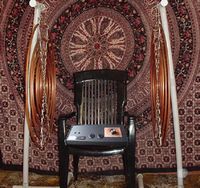
Multiwave
Oscillators
The Multiwave Oscillator is a cutting-edge
device that harnesses the power of electromagnetic
waves to promote vitality and well-being. By emitting
a series of precisely calibrated frequencies, the
MWO stimulates the body's natural energy field,
helping to restore balance and harmony.
Using advanced technology, the Multiwave
Oscillator generates a unique combination of electromagnetic
frequencies that resonate with the body's own energy
field. This resonance helps to enhance cellular
function, promote detoxification, and support overall
health and vitality.
More
information on the MK7 multiwave Oscillator click
here
Latest
MK9 multiwave Oscillator Click here
I
would like more information on the Multiwave
Oscillator |
|
Rife
machines and Multiwave
oscillators are claimed to complement each
other based on the principle that life forms
absorb energy. A multiwave
Oscillator uses this principle to strengthen
cells within the body to resist disease while
a Rife machine uses this principle to destroy
microorganisms with an overdose of frequency
energy. |
|
Enhance
Natural Killer
Cells with Frequenes
Rife
pro optio 2h-3ah most popular
"Royal
rife developed 5 units,the fith unit was the
most powerful"
""I can assure you that
no one, not even myself, could help but be astounded
at the results we are now obtaining with the assistance
of our new machines and our new band of MOR's.(Mortal
oscillatory rate)" (Letter from Dr. Johnson
to Dr. Gruner (copy sent to Dr. Rife) dated, November
4, 1936."."
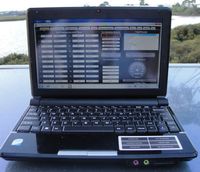
The
worlds most advanved multi purpose Fully
Automatic Rife/Hoyland System Read more here
The
Most Advanced Rife system
The
facts about Royal
rifes work
i
would like more information on your Rife systems
Testimonials |
 |
Rife
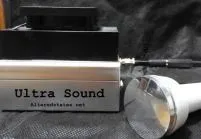
Ultrasound System
Rife Ultrasound unit
Ultra Sound Sender handpiece
Rife ultrasound Software
Standard Ultrasound frequencies of 0.5–0.67 MHz
Power supply
Hoyland connectors
Instructions
More
information here |
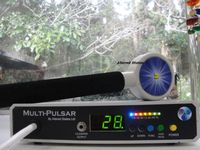 |
Multipulser
PEMF
Pulser combo
Very
powerful 6500-7000 gauss magnetic pulser
Bob beck
typer blood zapper
Colloidal
silver generator
Multipulser |
|