|
😴 CES & SLEEP
Could
a Tiny Electrical Signal Help a Restless Brain
Settle Down?
We
spend roughly a third of our lives asleep.
Yet
for millions of people, getting into bed doesn't
necessarily mean getting to sleep.
The
body may feel tired while the mind remains busy.
Thoughts
continue.
Stress
follows us into the bedroom.
And
that wonderful little switch marked OFF seems to have disappeared. 😂
Scientists
have therefore been investigating an interesting
possibility:
⚡ Could very
small electrical signals applied around the head
influence the brain activity associated with relaxation
and sleep?
That
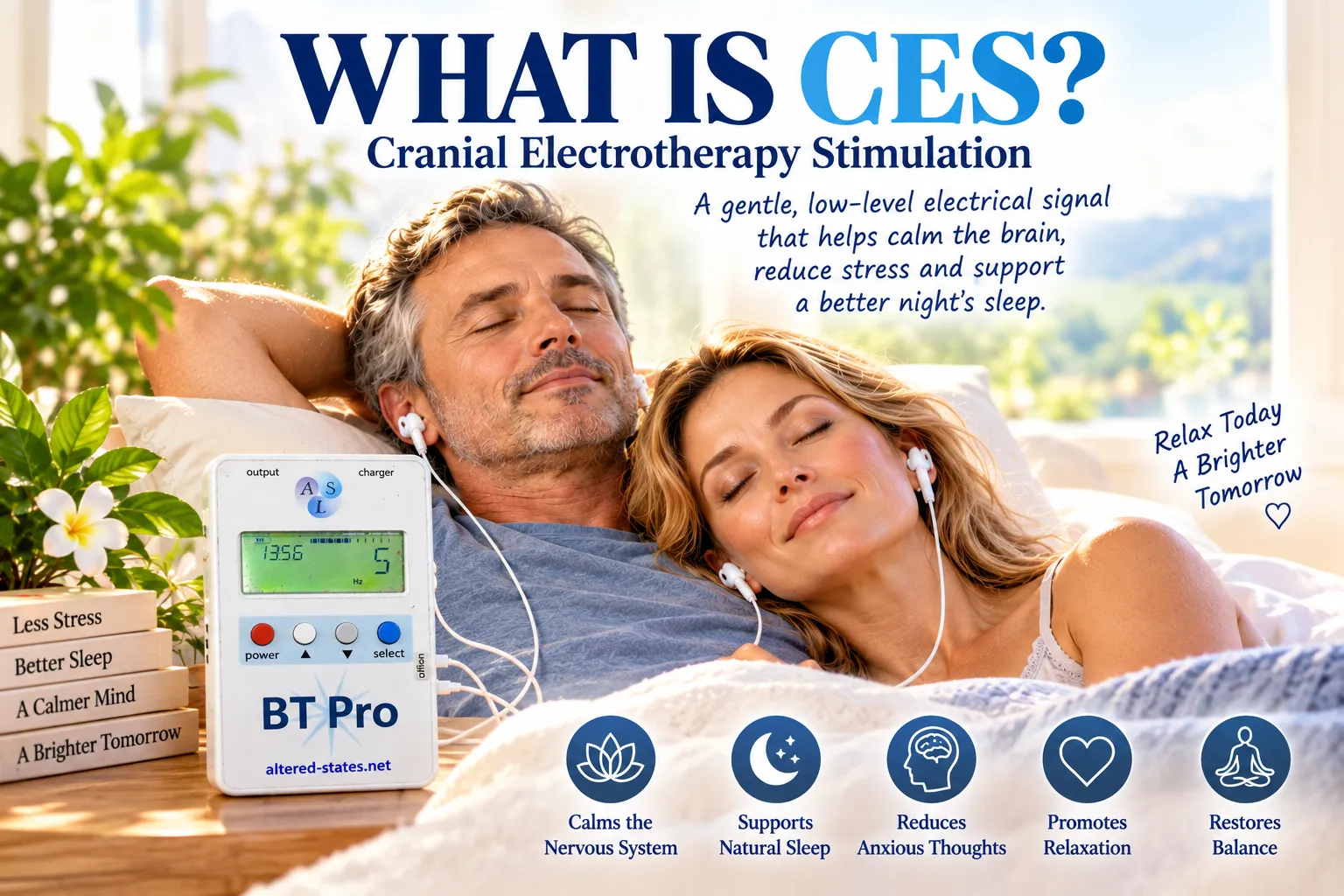
field of research is known as Cranial Electrotherapy Stimulation — CES.
🧠 WHAT
IS CES?
CES
uses very small electrical currents delivered through
electrodes, commonly attached around the ears or
head.
It
isn't ECT.
It
doesn't attempt to produce a seizure.
We're
talking about microcurrent-level electrical stimulation designed to interact gently with the nervous system. Different CES devices use
different frequencies, waveforms, currents and electrode
arrangements, which becomes important when comparing
studies.
Think
of it less as:
⚡ “Shocking
the brain”
and more
as:
🌊 “Introducing
a very small electrical signal into an already
electrical system.”
After
all, your brain already communicates through extraordinarily
complex electrochemical activity.
🌙 CES
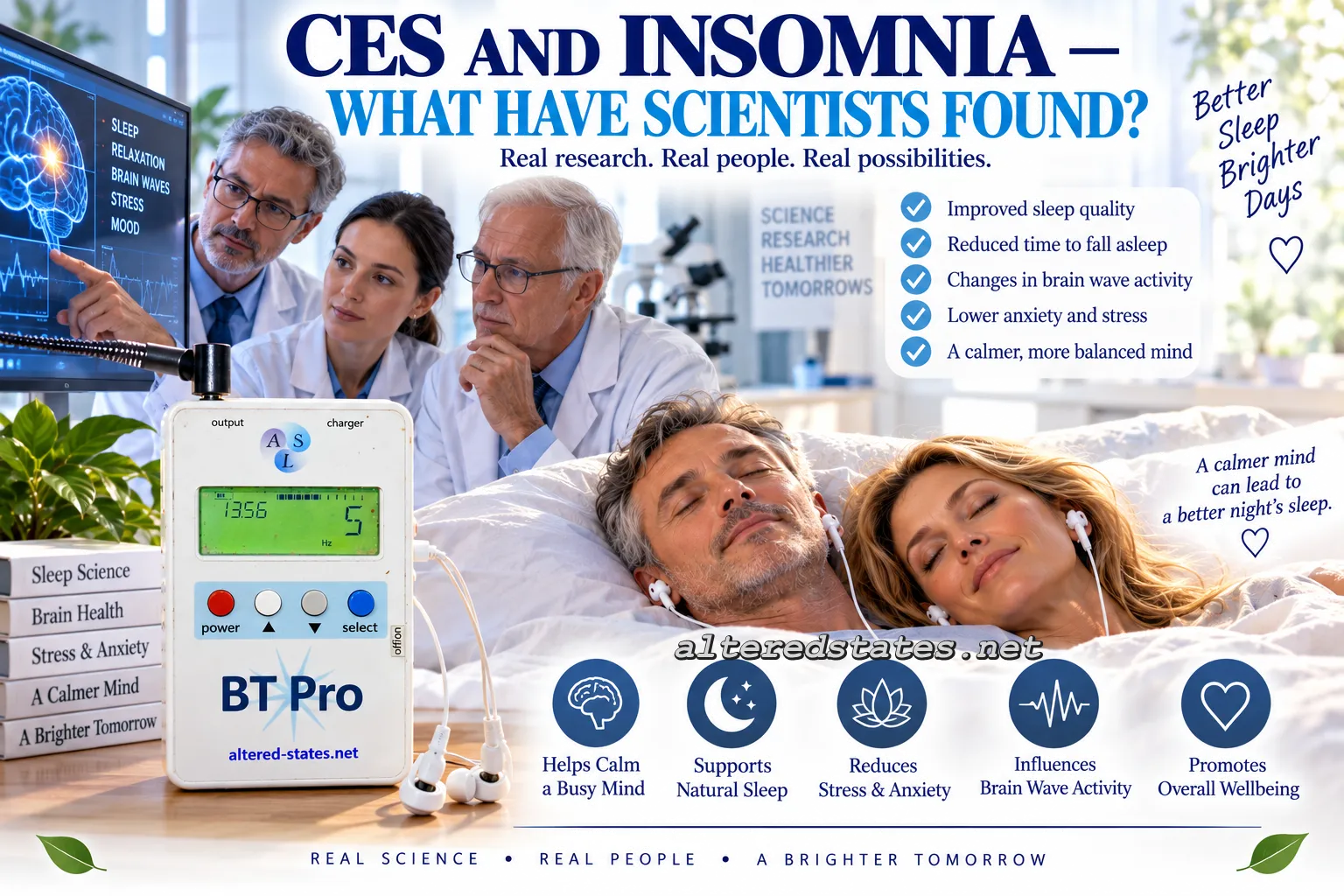
AND INSOMNIA — WHAT HAVE SCIENTISTS FOUND?
🔬 Study
#1 — People With Insomnia
A
particularly useful study came from Walter Reed National
Military Medical Center.
Researchers
recruited 57 active-duty military personnel with significant insomnia symptoms and randomly assigned them to real CES or a sham device.
They
received:
⚡ 60
minutes CES
📅 Once daily
for 5 days
😴 Sleep onset measured
⏰ Total sleep time measured
🌙 Nighttime awakenings
measured
There
was a suggestion of increased total sleep time during
treatment, but importantly, the differences between
real and sham CES did not reach conventional statistical significance for the principal sleep measurements.
So
this study gives us a useful scientific result
🌿 Study
#2 — CES Changes Sleep Physiology
Researchers
at Charité University Hospital in Berlin performed a randomized controlled experiment in
healthy women.
Rather
than relying only upon people saying:
“I
slept better.”
the researchers
examined sleep physiologically.
They
reported that CES produced measurable changes in
sleep, including effects on sleep-stage distribution and slow-wave sleep, although the results did not amount to a simple demonstration that CES cures
insomnia.
That
raises an intriguing possibility:
🧠 CES
may interact with the physiology of sleep itself.
🏃♀️ Study
#3 — Athletes With Poor Sleep
In
2022 researchers studied 40 athletes with poor sleep quality before competition.
Twenty
received CES and twenty received sham stimulation
for two weeks.
The
researchers measured far more than questionnaires:
❤️ Heart-rate
variability
⌚ Actigraphy sleep
measurements
🧠 Mood
⚡ Reaction time
🧪 Cortisol and
other biochemical measures
CES
significantly reduced several negative mood measures
and altered autonomic nervous-system measurements
compared with placebo.
Sleep
efficiency itself did not simply improve; the researchers described the overall sleep effect as small, with CES appearing
to slow deterioration in sleep efficiency during
the stressful pre-competition period.
🧠 Study
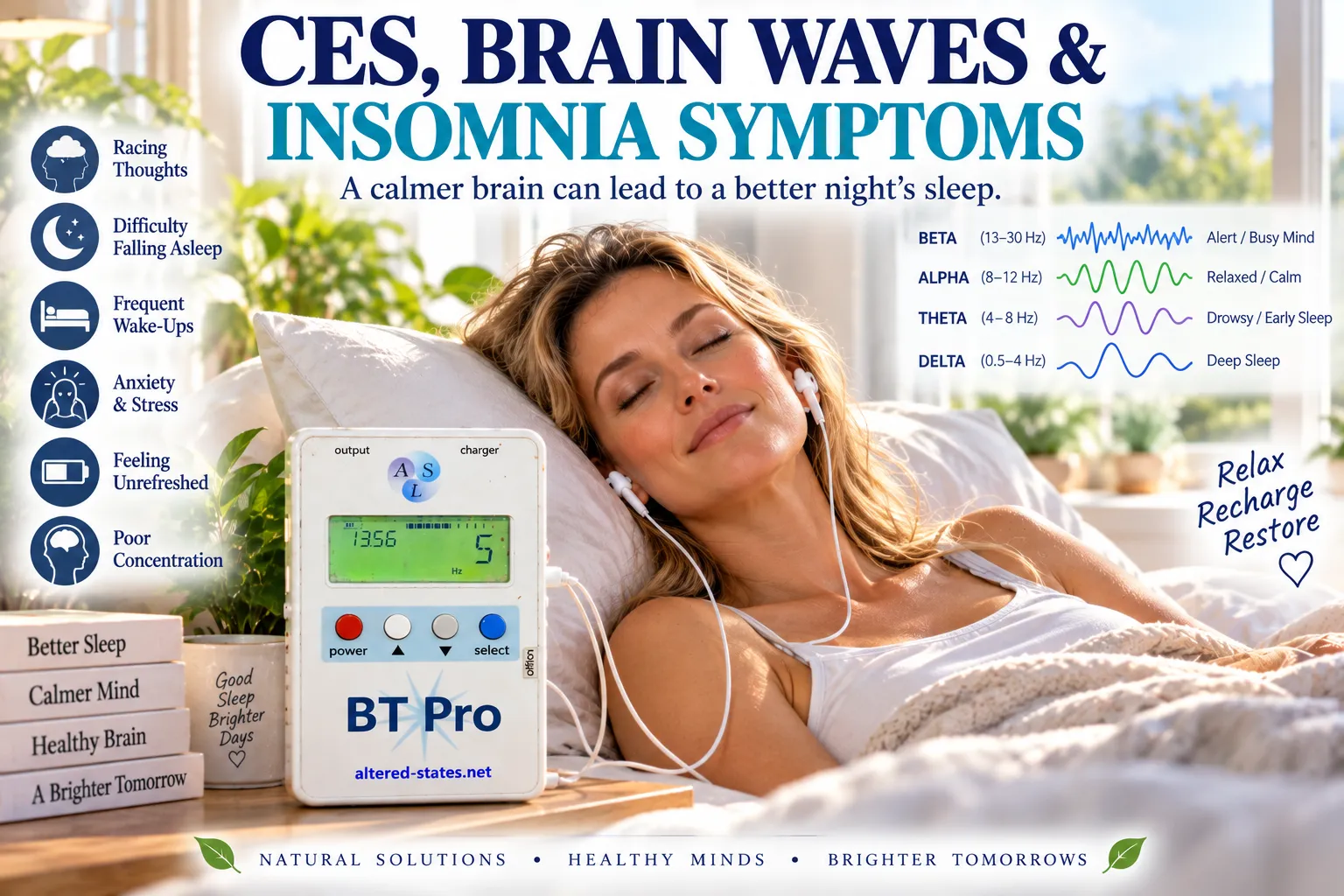
#4 — CES, BRAIN WAVES & INSOMNIA SYMPTOMS
A
newer randomized study involved 59 people with subclinical insomnia.
Participants
used CES:
⚡ 30
minutes per session
☀️ Twice daily
📅 For two weeks
Researchers
measured sleep questionnaires, actigraphy and — particularly interesting for us — 64-channel EEG brain activity.
Both
real CES and sham groups reported better sleep, without
a significant difference between them.
But
CES produced significantly different EEG changes
involving:
🌊 Delta
activity
🌊 Theta activity
🌊 Beta activity
The
CES group also showed statistically significant improvements
over sham in depression scores and physical well-being.
That
gives us another interesting clue.
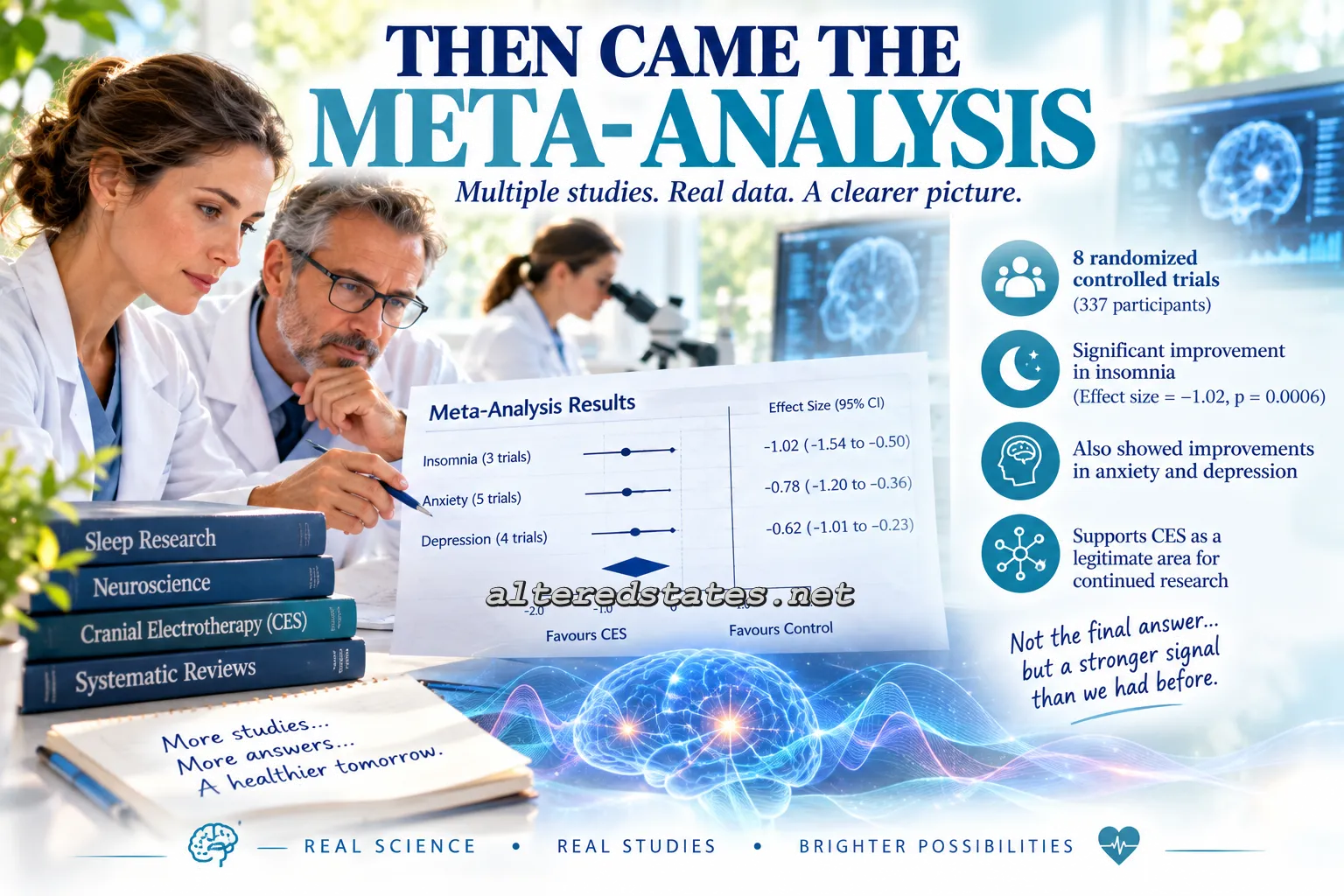
📊 THEN CAME THE
META-ANALYSIS
Rather
than looking at one experiment, researchers published
a systematic review and meta-analysis in 2023 combining
randomized CES trials involving people whose primary
complaints included anxiety.
They
identified:
👥 337 participants
🔬 8 randomized controlled trials
Across
three trials reporting insomnia outcomes, CES showed
a statistically significant improvement in insomnia
compared with control conditions:
Effect
size = −1.02
p
= 0.0006
The
analysis also found improvements in anxiety and depression
outcomes.
⚡ WHY
COULD CES AFFECT SLEEP?
This
may be where the story becomes especially interesting.
Sleep
isn't simply unconsciousness.
It
involves beautifully organized changes in:
🧠 brain electrical
rhythms
❤️ autonomic
nervous-system activity
🌊 slow-wave activity
😌 arousal and relaxation
⏰ circadian regulation
🧪 neurochemical signaling
CES
introduces a controlled electrical stimulus into
this electrically active system.
Researchers
are investigating whether that stimulation can influence neural oscillations, cortical activity and autonomic regulation.
The
EEG findings showing changes in delta, theta and
beta activity make this particularly interesting.
🌊 YOUR
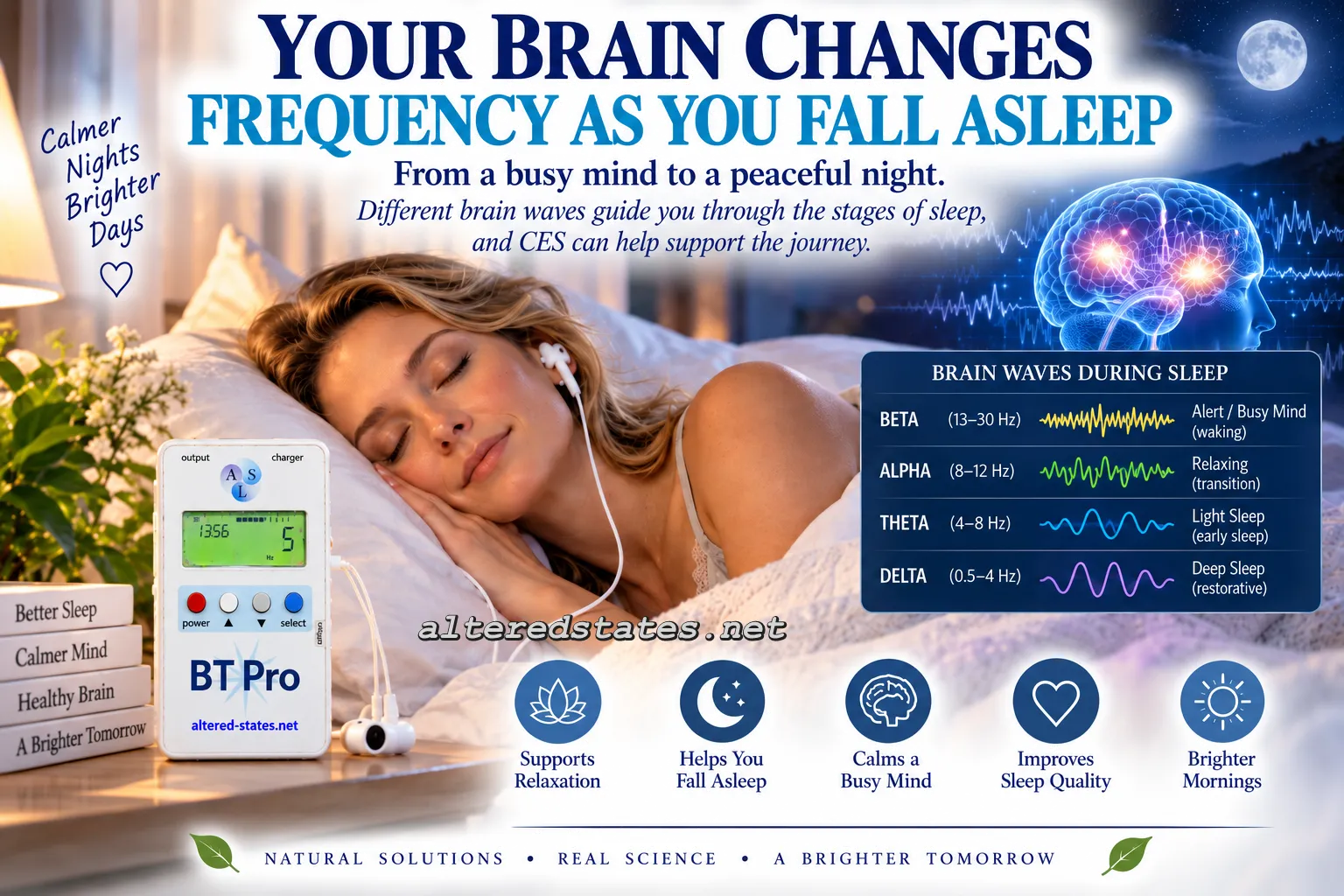
BRAIN CHANGES FREQUENCY AS YOU FALL ASLEEP
During
normal wakefulness, EEG activity contains considerable
faster-frequency activity.
As
we relax and move toward sleep, the pattern changes.
😌 ALPHA
Approximately 8–12
Hz
Often
associated with relaxed wakefulness and eyes-closed
rest.
🌙 THETA
Approximately 4–8
Hz
Becomes
increasingly prominent during lighter stages of
sleep.
💤 DELTA
Approximately 0.5–4
Hz
Prominent
during deep, slow-wave sleep.
So
sleep isn't simply:
ON → OFF.
It
represents a remarkable change in the electrical organization of the brain.
🔬 WHAT
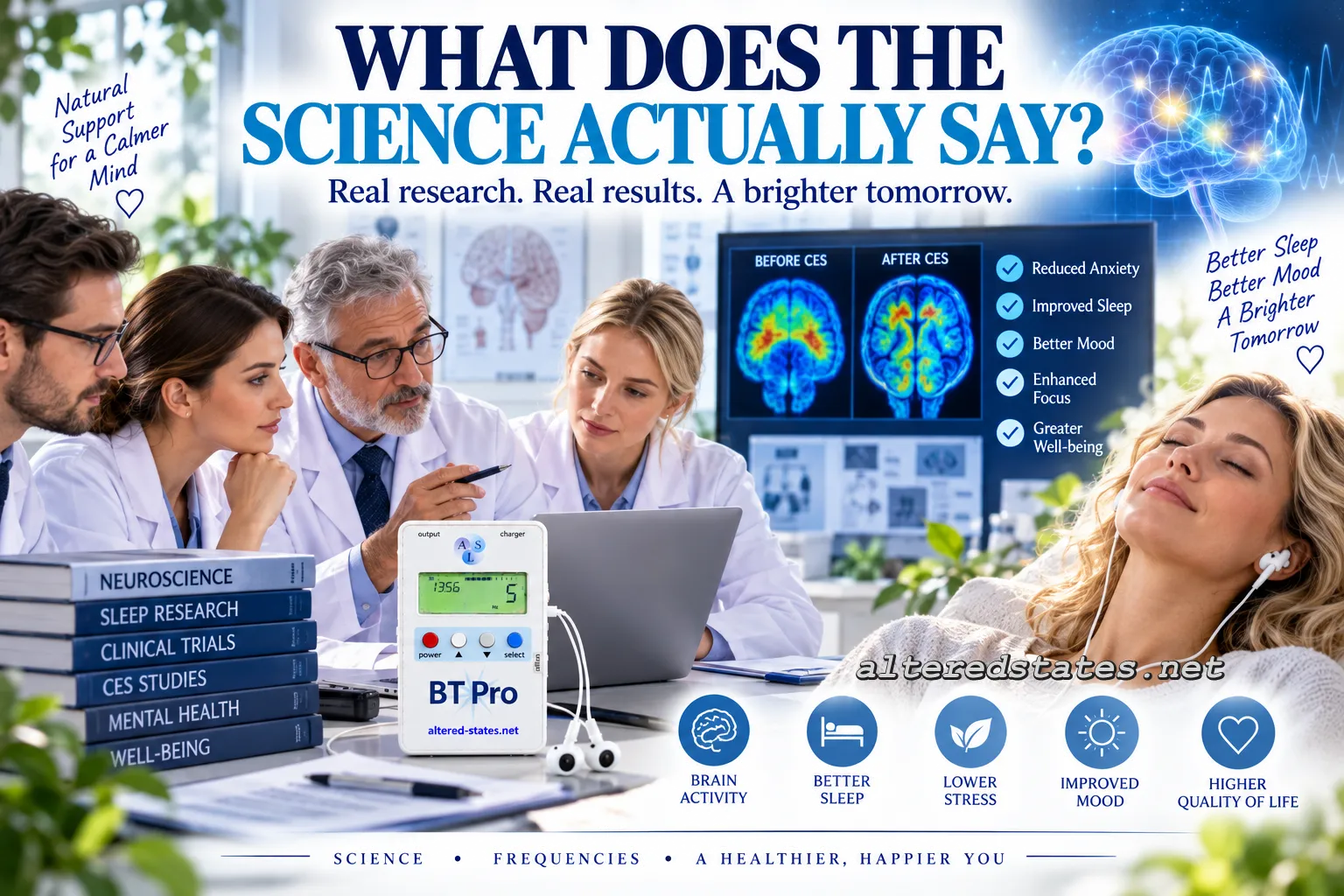
DOES THE SCIENCE ACTUALLY SAY?
The
fairest summary looks like this:
🟢 CES
can measurably influence brain and autonomic activity.
🟢 Controlled
studies report encouraging sleep-related effects.
🟢 A 2023
meta-analysis found significant improvement in
insomnia among people with anxiety symptoms.
🟡 Some studies
find subjective sleep improvements in both CES
and placebo groups.
🟡 Individual
studies tend to be relatively small.
🔴 CES
has not consistently beaten sham stimulation in
dedicated insomnia trials.
That
last point doesn't destroy the subject.
It
tells us where the science currently stands.
🌙 SOMETIMES
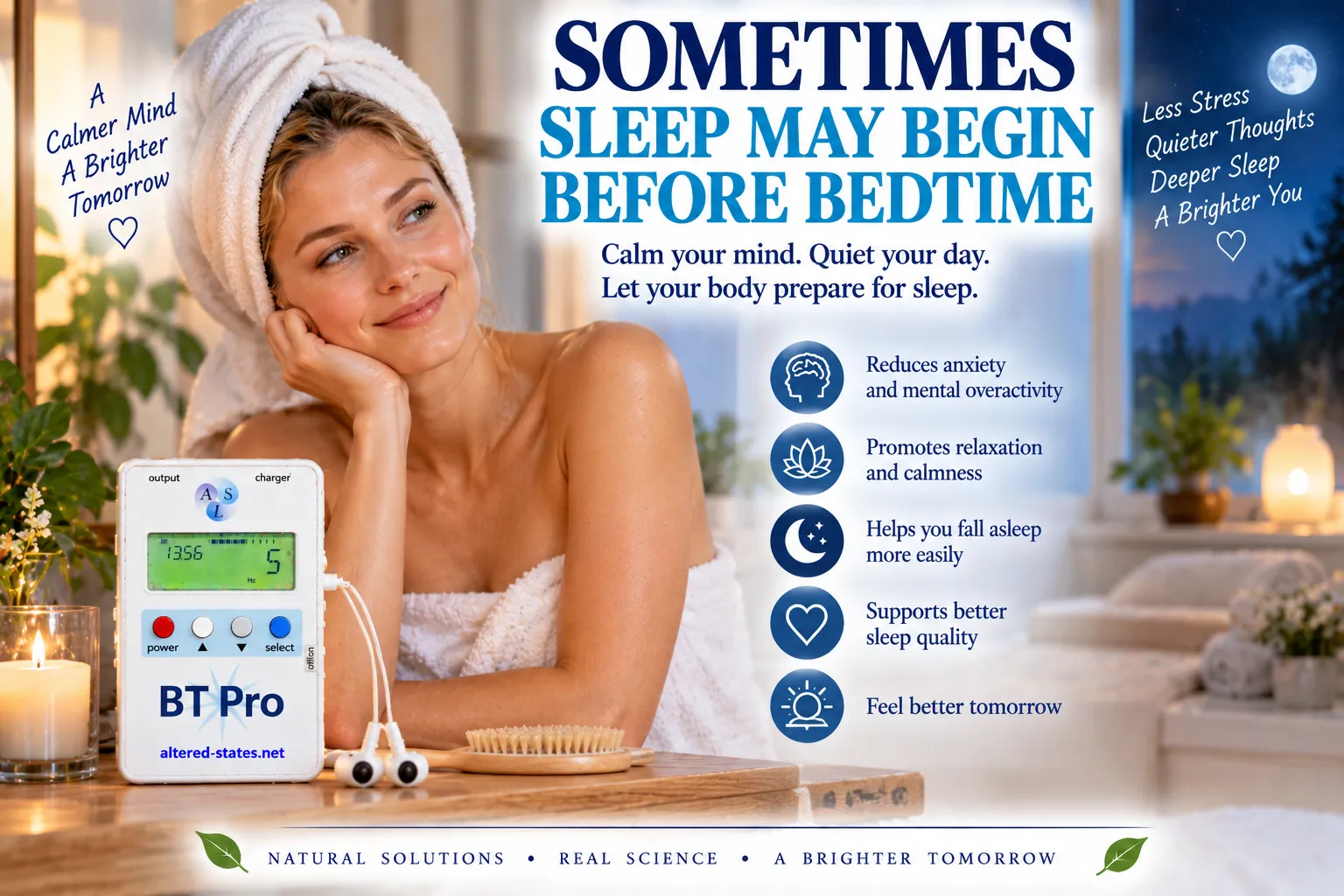
SLEEP MAY BEGIN BEFORE BEDTIME
Perhaps
the interesting question isn't simply:
“Can
CES make somebody sleep?”
It
may be:
Can
CES help shift an overactive nervous system toward
a state in which sleep comes more naturally?
Because
when anxiety, tension and mental activity keep the
nervous system switched on, the difficulty may not
begin when someone's head hits the pillow.
It
may begin hours earlier.
And
several CES studies showing changes in anxiety, mood, autonomic activity and EEG rhythms make that question worth investigating.
✨ THE
BIGGER PICTURE
For
decades we tended to think about sleep largely in
chemical terms.
Melatonin.
Sedatives.
Neurotransmitters.
Hormones.
But
the sleeping brain also undergoes extraordinary electrical changes.
Perhaps
chemistry and electricity were never competing explanations.
🧠 The brain
is chemical.
⚡ The brain
is electrical.
🌙 And healthy
sleep depends upon an extraordinarily complex conversation
between the two.
That
makes CES a fascinating area of modern sleep research
— not because every question has been answered, but precisely because they haven't.
Sometimes
the smallest signal can raise the biggest questions.
📚 Scientific papers
Lande & Gragnani,
2013 — randomized double-blind sham-controlled CES
insomnia pilot. PMID 23374200; DOI 10.1016/j.ctim.2012.11.007.
Wagenseil et
al., 2018 — CES and sleep in healthy women. PMID 30475746; DOI 10.1088/1361-6579/aaeafa. Chang et al., 2022 — CES in athletes with poor sleep quality. PMID 35206134; DOI 10.3390/ijerph19041946. Hong et al., 2023/2024 — CES, sleep, mood and EEG in subclinical insomnia. PMID 37366366; DOI 10.1111/jsr.13978. Ching et al., 2023 — systematic review/meta-analysis of CES for anxiety, depression
and insomnia. PMID 37091717.
Shekelle et
al., 2018 — systematic review of CES including
insomnia trials. PMID 29435567.
|




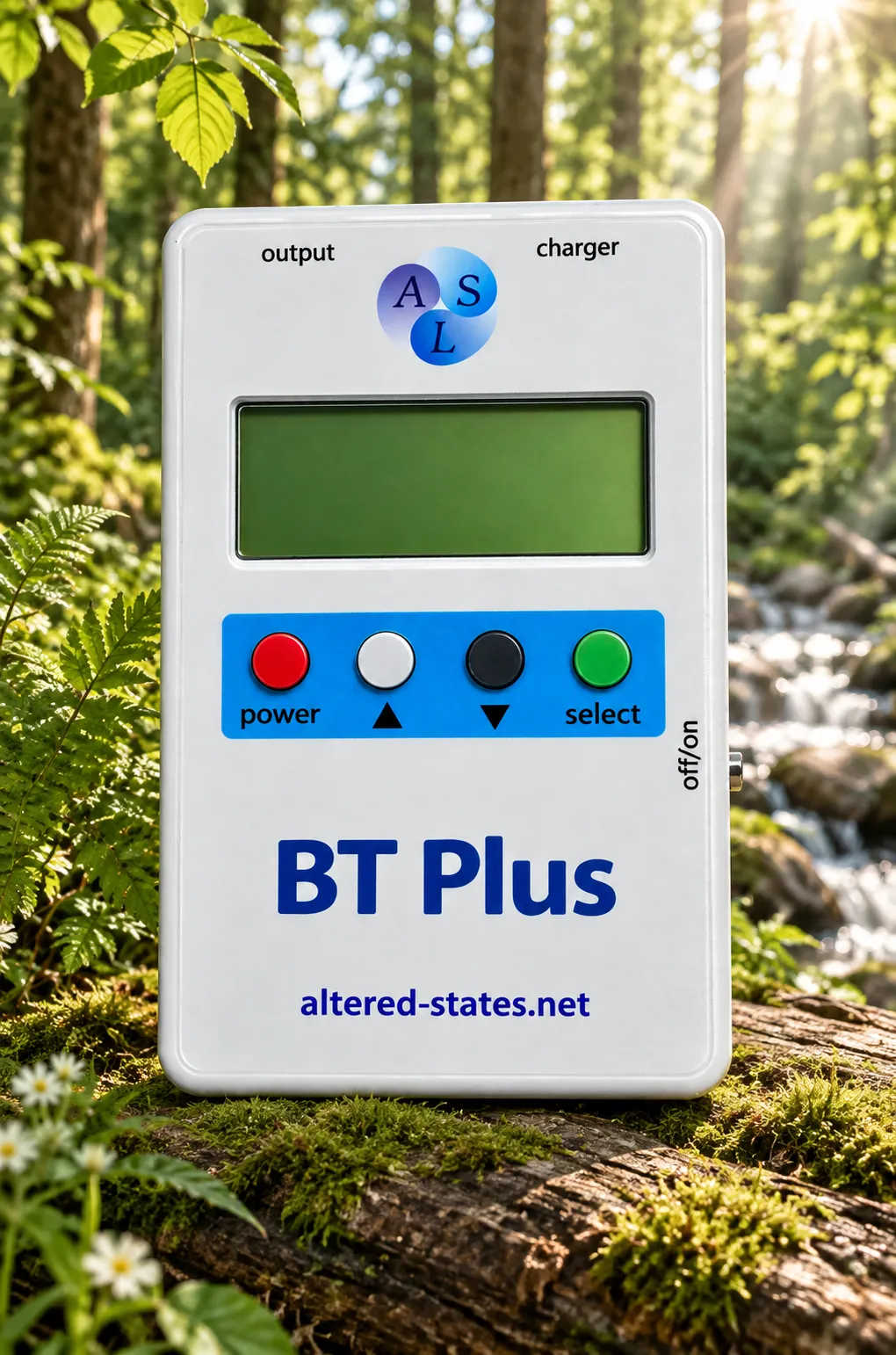
 Full
LED screen
