Brain May Grow New Cells Daily
"Brain
May Grow New Cells Daily," by Nicholas Wade, If so, several experts said, it may overturn ideas about how the human brain works and open new possibilities for treating degenerative brain diseases.
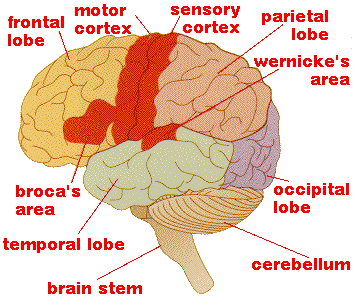
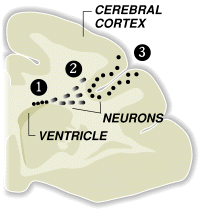
-------------------------------------------------------------------------------- In addition, if the brain's cells are in constant turnover, as the new finding suggests, physicians may discover ways to use the brain's natural regeneration system for replacing cells that are lost in diseases of aging. The discovery, by Elizabeth Gould and Charles G. Gross, is reported in Friday's issue of the journal Science. The belief that the adult brain does not make new cells rested on careful, well-known studies by Pasko Rakic of Yale University, who looked for the formation of new neurons in the monkey brain and found none. But the Princeton work is likely to be convincing, because it builds on previous reports of brain cell turnover, notably by Fernando Nottebohm of Rockefeller University, who showed that canaries grow new neurons to learn new songs, and recent studies showing that new cells are formed in the hippocampus, a brain region where initial memories of faces and places are formed. "The scientific community can easily believe something it is 50 percent ready to absorb, but not something that comes out of left field," said Eric R. Kandel, a leading neuroscientist at Columbia University. "But here, we are prepared for it." Kandel compared the likely change in view to the paradigm shifts described by the historian of science Thomas Kuhn as occurring when one major scientific theory is replaced by another. Although the new study was done in macaque monkeys and has yet to be confirmed in humans, as fellow primates monkeys are usually quite predictive of what occurs in people. Gould, who has studied new cell formation in the hippocampus, and Gross, an expert on the cerebral cortex, injected macaques with a chemical that is incorporated in the new DNA formed when a cell divides. They found that a stream of new neurons were generated in the monkeys' brains in a zone just above the brain's fluid-filled central chambers. This zone was recently identified by other scientists as the home of the brain's stem cells, the source cells from which an organ is replenished. The new neurons migrated toward the cortex, matured and sent out axons to make connections with other brain cells, the Princeton biologists found. The researchers looked for new neurons in four areas of the cortex, and found them in three areas where memories are known to be stored: the frontal cortex, used for decision-making, and two areas on the side of the brain used for visual recognition. No new neurons were detected in the fourth area, the striate cortex, a region at the back of the head that simply processes visual information from the eyes and passes it on to other parts of the cortex. Whatever the new cells are doing in the cortex, they affect regions of the brain that are central to human thought and identity. The Princeton work, said Ronald D. G. McKay, an expert on brain stem cells at the National Institutes of Health, "places new neurons in the region of the brain involved in the highest level of personality: it's the frontal cortex that is important in determining who you are in a very human way." Gould said it was possible that the new neurons arriving in the cortex would be particularly sensitive to recording information for a certain period while they matured. "They would become integrated in the circuitry and represent the information being learned at that particular time," she said, after which they would not record anything more. In other words, the conveyor belt of new neurons might record successive days' experiences almost like a moving tape. "We know the characteristic of memory is that events are tagged with times," Gross said. "We have no idea how that is done. But since we have now shown there are new cells added every day, which cover a spectrum of ages, these cells could possibly provide the substrate for the temporal dimension of memory." Kandel, of Columbia University, said the idea was perfectly possible, given how little was now known about the brain's system for ultimate long-term memory storage. "How do you distinguish the memory of 20 years ago from the memory of 30 years ago? You would have to mark the birthday of the cell in some way," Kandel said, suggesting that the train of new neurons offered a plausible mechanism whereby the brain might somehow do this. The notion that new memories are stored in a train of new nerve cells was advocated in the 1960's by Joseph Altman, then of the Massachusetts Institute of Technology. But his proposal was not widely accepted. And when Rakic, an authority on neuron formation in the embryonic monkey brain, reported in 1985 that no new neurons were formed in the adult monkey's brain, this became the accepted view. Even when Gould and others showed recently that new cells were formed in the hippocampus, Rakic argued that this was a primitive area of the brain -- even reptiles have a hippocampus -- and that brain organs acquired more recently in evolution, like the primates' cerebral cortex, would not be expected to behave the same way. Gould said it was this argument that had made her determined to look for new cells being formed in the cerebral cortex, despite the expense of doing work on monkeys and the risk in "redoing an experiment that a very well respected person," Rakic, had already performed. Rakic's office said he was traveling yesterday and unavailable for comment. If indeed the brain is constantly renewing the cells in its cortex, hippocampus and maybe other areas, the prospects for learning how to repair the aged or damaged brain begin to look much more hopeful. "Degenerative diseases of the brain are really defined by loss of nerve cells," Kandel said. Though diseases like Parkinson's affect specific areas of the brain, it might become possible to channel young new neurons into the areas of disease. "This is pie in the sky," he said, "but at least there is now the possibility of thinking about it." William T. Greenough, a neuroscientist at the University of Illinois, said the Princeton work created a "whole new ball game" for addressing brain diseases, by harnessing the brain's own restorative potential. The Princeton biologists plan to follow up their discovery by blocking the formation of new neurons in monkeys' brains and seeing what happens. If the new neurons are essential for memory and learning, then serious deficits should appear in the monkeys' performance. The researchers as yet have no idea whether the loss of brain cells and the generation of new ones are separate events or part of the same cycle. "Our discovery," Gross said, "suggests
more questions than answers." Salk Institute Study Finds Brains
Can Grow New Cells
COMPLETELY REDUCE
STRESS AND ENCOURAGE BRAIN CELLS
BRAIN CELL GROWTH AFFECTED BY STRESS For years, neurobiologists clung to a fundamental truth: as
animals and people reach adulthood, they lose brain cells and they never
grow new ones. There were a couple of exceptions such as birds and rats,
but the thought was that these were peculiarities of nature and not
evidence of a general principle. Experts say they fully expect that humans are no different and that they, too, make new brain cells in adult life. That raises the glimmer of a possibility of eventually treating degenerative disorders like Alzheimer's or Parkinsons disease and injuries such as those resulting from stroke or trauma — by prompting the brain to grow replacement cells. It also means that neurobiologists must rethink basic notions of the way the brain changes with learning or life experiences. Dr. Elizabeth Gould of Princeton University, Dr. Bruce S. McEwen of Rockefeller University in Ncw York and their colleagues investigated using marmoset monkeys, adding two tracer chemicals to the animals' brains: one that labeled cells that were dividing — the process that gives rise to new cells and one that labeled mature nerve cells. Cells that were born during adult life and that grew into mature brain cells would be marked by both chemicals. With this method, the researchers looked for, and found, new cells in the animals' hippocampuses. Dr. Gould estimated that thousands of such cells were being made each day. She said she suspected other cells were dying to make room for new ones, but her study did not count numbers of dying cells. The hippocampus was particularly intriguing for another reason, Dr. Gould said. Earlier research had shown that when people are under stress, the hippocampus shrinks in size. For example, people with tumors that pour out the stress hormone cortisol have a diminished hippocampus. So do people with recurrent depression and people with posttraumatic stress disorder, Dr. Gould said. It might be possible, she reasoned, that monkeys under stress might decrease their production of new brain cells in the hippocampus, making that area of the brain shrink. To test the hypothesis, Dr. Gould and her colleagues stressed monkeys by putting a male monkey who had always lived alone into a small cage where another male was living. The intruder was terrified and cowered in the cage, with a rapidly beating heart. When Dr. Gould and her colleagues examined the brains of the frightened monkeys, they found that after just one hour of this stress, the monkeys were making substantially fewer new I brain cells. The study is being published in The Proceedings of the National Academy of Sciences. As so often happens in science, the seeds for the new view of brain regeneration were sown decades ago, but were largely ignored. In the 1960s, Dr. Joseph Altman, a Purdue University scientist who is now retired, reported that rats make new brain cells throughout their lives. The cells were in the hippocampus and in the olfactory bulb, an area used to sense smells, he noted. "No one paid attention,"Dr. Gould said. Twenty years later, Dr. Fernando Nottebohm, who is head of the laboratory of animal behavior at Rockefeller University, asked whether brain cells were being born in adult birds. Bird brains, he noticed, grow and shrink with the seasons, swelling when the animals need to learn new songs to attract mates and shrinking after they had bred. He wondered whether the swelling brains during breeding seasons could represent the actual growth of new brain cells. At the time, Dr. Nottebohm said, he knew nothing of Dr. Altman's work. In a series of painstaking experiments, Dr. Nottebohm showed that birds constantly make new brain cells and that the new cells replace old ones that die. "There was a program of constant brain rejuvenation,"Dr. Nottebohm said. In 1984, Dr. Nottebohm organized a meeting in New York that he called Hope for a New Neurology A colleague at Rockefeller, Dr. Arturo Alvarez-Buylla recalled that Dr. Nottebohm "was pushing the idea that in the adult brain, there is no impediment to the formation of new neurons." But, Dr. Alvarez-Buylla added, "people thought that was bordering on fantasy."Nonetheless, some researchers persisted, showing in rats and mice and in tree shrews that new brain cells are born throughout life, at least in the hippocampus and olfactory bulb. Dr. Alvarez-Buylla, for example, recently found that adult mice make 5,000 to 10,000 new brain cells each hour. The brain cells that end up in the olfactory bulb are born on the walls of the ventricles, cavities in the brain that are called with cerebrospinal fluid. They travel in "little trains of cells" to their destination, he said. Those that end up in the hippocampus are born there. But many scientists believed that monkeys and humans could not be growing new brain cells -- that in order to store memories for a lifetime, you need a stable brain. Dr. Gould said. "If cells are constantly dying and new ones being produced, how would that be possible?" Dr. Gould, however, was persuaded by the findings on other species. ''Why not monkeys?" she asked. Others also began seeking and finding brain regeneration in monkeys, but Dr. Gould is the first to publish her findings.
Can anything be done about this? Are we destined
to lose our faculties as we age? There is some hope on several fronts.
Recent research on Alzheimer's Disease suggests that there might some
day be a vaccine that protects us from Alzheimer's build-up of plaques
and tangles in our brains. Some studies suggest that physical exercise
keeps brains healthy. There is also research that suggests that we can
keep our brains working well by using them regularly. This is the principle
behind a recent book by Lawrence Katz, Ph.D. and Manning Rubin. Katz
is a neuroscientist at Duke University who studies brain aging. Their
book, Keep your Brain Alive, describes practical exercises that anyone
can do to keep the brain working at top efficiency. Eating or brushing
your teeth with your non-dominant hand, for example, allows your brain
to use pathways that are not frequently accessed. You sit down comfortably, don the electrical headgear, flip a switch, close your eyes and sink into a state of what seems like deep relaxation. A half hour later, as you turn off the machine, you feel extremely alert and lucid. Your brain is now functioning more effectively than it was before. Your memory both your ability to memorize new information and to recall information you have already learned has increased dramatically. Your ability to think creatively, to solve problems, has expanded. The speed with which your brain cells pass messages among themselves has increased. In fact, many of your brain cells have actually grown a microscopic examination would show that the brain cells have developed more dendrites, the branching filaments that carry messages from one cell to another, and more synapses, the junctures between the brain cells across which impulses are transmitted. You are more intelligent than you were a half hour before. Such devices now exist and are being used by increasing numbers of people. So begins Michael Hutchison's book Megabrain ("Mega" derived from the Greek word for great or powerful). For close to 10 years, we have researched, designed, and marketed mind machines as well as trained people how to use these amazing tools. You don't know what you've missed until you experience the profound changes in your alertness, creativity, memory, and happiness that can result from 30 minutes a day with one of these systems!
COMPLETELY REDUCE
STRESS AND ENCOURAGE BRAIN CELLS |