“As
long as there is breath in my body
I will never ever cease to be a seeker after truth.”
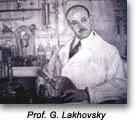
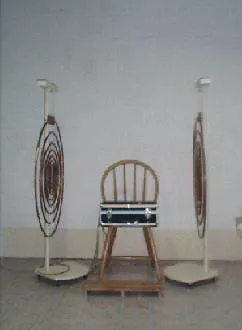
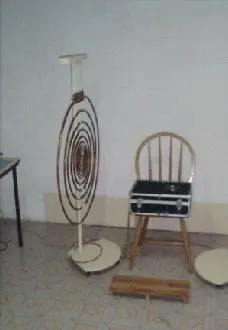
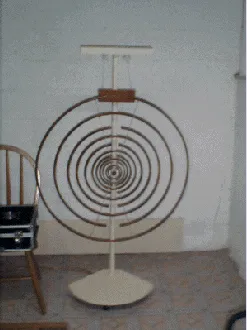
Lakhovsky's
Multiple Wave Oscillator
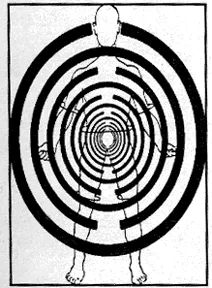
In the 1925 Georges Lakhovsky in France developed
a coil for the protection of trees; copper wire was stuck into the ground,
turns were made around the tree, and the loose end was pointed towards
the sky as an aerial. In 1928 he formed a variation of this that was geared
to improve the health of humans, which he called the ‘multi-wave
oscillator’, based on his then new theory that cells are microscopic
oscillating circuits.
This was successfully used in French, Italian, and Swedish clinics, and
when Lakhovsky escaped to the USA in 1941 it proved successful in a major
New York hospital. Among problems successfully treated were cancerous
growths from Radium burns, goiters, arthritis, chronic bronchitis, congenital
hip dislocation, and many others. (Tompkins & Bird: ‘Secret
Life of Plants’).
What Lakhovsky discovered was simply mind boggling:
He postulated that all living cells (plants, people, bacteria, parasites,
etc.) possess attributes which normally are associated with electronic
circuits. These cellular attributes include resistance, capacitance, and
inductance. These 3 electrical properties, when properly configured, will
cause the recurrent generation or oscillation of high frequency sine waves
when sustained by a small, steady supply of outside energy of the right
frequency. This effect is known as resonance. It's easiest to compare
it with a child swinging on a playground swing. As long as the parent
pushes the swing a little at the right moment (the correct 'frequency'),
the child will continue to swing high and continuously. In electronics,
circuits which generate these recurrent sine waves can be called electromagnetic
resonators, but more commonly they are referred to as oscillators.
T E S L A The lost Inventions
by George Trinkaus
Here are the suppressed inventions of Nikola Tesla all in one place rendered
in clear English and in 42 illustrations. Tesla was famous at the turn
of the century for inventing the alternating current system still in use
today. But his later inventions, documented in some 30 U.S. patents between
1890 and 1921, have never been utilized as Tesla intended despite their
obvious potential for advancing in fundamental ways the technology of
modern civilization. Among these lost inventions: the disk-turbine rotary
engine, the tesla-coil electric energy magnifier, high-frequency lighting
systems, the magnifying transmitter, wireless power, and the free-energy
receiver. about this book
Except that I have built a tesla coil, I have no special direct knowledge
of Tesla. I never knew the man. I am not his "channel." This
work is, simply one person's distillation of the existing Tesla literature.
Particularly, this book is derived from Tesla's patents. I have also drawn
upon his published notes and lectures, his magazine articles, as well
as biographies and other secondary sources. But most of my energy has
gone into translating into informal English the techno-legalese of the
patents. Tesla was eloquent in English (and several other languages as
well). This shows in his patents, and I quote him extensively. But Tesla's
patents, like all patents, make tough reading, because they are not written
for the curious but are defensive, legalistic exercises designed to protect
the inventor's interests. about the author
Like many of us, I have been fascinated with electricity since my youth.
I was a pre-teen basement experimenter and a novice-class ham (WN3UEH).
I read many of the conventional books on the subject My liberal arts college
offered just one course in electronics;
I
took it. Out in the corporate world, as an editor of textbooks, I presided
over the publication of a series of basic electronics books for the schools.
But, now, I confess: I never really understood how electricity works until
I read Tesla. I had to deschool myself to write this book. Tesla
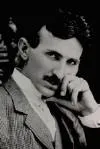
TESLA, tes'le Nikola (1856-1943), electrical inventor. Born Yugoslavia.
Educated at the polytechnical school at Graz and at University of Prague.
Worked as telephone engineer in Prague and Paris. Conceived new type of
electric motor having no commutator, as d.c. motors have, but works on
principle of rotating magnetic field produced by polyphase alternating
currents. Constructed prototype. Found nobody interested in Europe. Emigrated
to U.S. (1884). Worked briefly and unhappily with Thomas Edison. Established
own lab and obtained patents on polyphase motors, dynamos, transformers
for a complete a.c. power system. Formed alliance with George Westinghouse,
who bought polyphase patents for $1 million plus royalty. With Westinghouse,
engaged in struggle against Edison to convince public of efficiency and
safety of a.c. over d.c. Succeeded in getting a.c. accepted as the electric
power system worldwide. Also with Westinghouse, lit the Chicago World's
Fair, built Niagara Falls hydro-power plant, and installed a.c. systems
at Colorado silver mines, other industries. By turn of the century was
lifted to celebrity status comparable to Edison's as media promoted him
along with the expanding electric power industry. Experimenting independently
in Manhattan lab, developed and patented electric devices based on superior
capabilities of high-potential, high-frequency currents: tesla coil, radio,
high-frequency lighting, x-rays, electrotherapy. Suffered lab fire. Rebuilt,
continued. Moved lab to Colorado Springs for about one year (1899). Built
huge magnifying transmitter. Experimented with wireless power, radio,
earth resonance. Studied lightning. Created
lightning.
Returned to New York. With encouragement of financier J.P. Morgan, promoted
a World System of radio broadcasting utilizing magnifying transmitters.
Built huge tower for magnifying transmitter at Wardencliff, Long Island
as first station in World System. Received enough from Morgan to bring
station within sight of completion, then funds cut off, project collapsed.
Continued to invent into the 1920's, but flow of patents meager compared
to earlier torrent which amounted to some 700 patents worldwide. High-frequency
inventions ignored by established technology, as were disk turbine, free
energy receiver, other inventions. Shut out by media except for birthday
press conferences. At these predicted microwaves, TV, beam technologies,
cosmic-ray motor, interplanetary communications, and wave-interference
devices that since have been named the "Tesla howitzer" and
the "Tesla shield." In the 1930's involved in wireless power
projects in Quebec. Last birthday media appearance in 1940.
Died privately and peacefully at 87 in New York hotel room from no apparent
cause in particular. Personal papers, including copious lab notes, impounded
by U.S. Government, surfaced many years later at a Tesla Museum in Belgrade
Yugoslavia. Of these notes, only a fragment, Colorado Springs Notes, has
been published by the Museum. 1. Disk-Turbine Rotary Engine
Tesla
called it a "powerhouse in a hat." One version developed 110
h.p. at 5000 RPM and was less than ten inches in diameter. Tesla believed
larger turbines could achieve 1000 h.p. The disk-turbine rotary engine
runs vibration free. It is cheap to manufacture because nothing but the
rotor bearings needs to be fitted to close tolerances. It requires little
maintenance. If necessary, the rotor can be replaced with ease. The turbine
can run on steam, compressed air, gasoline, or oil. how it works
Unlike conventional turbines that use blades or buckets to catch the flow,
Tesla's uses a set of rigid metal disks that, instead of battling the
propelling stream at steep angles, runs with smooth efficiency in parallel
with the flow. What drives the disks is a peculiar adhesion that exists
between the surface of a body and any moving fluid. This adhesion, a hinder
vehicles, is, in Tesla's words, caused by "the shock of the fluid
against the asperities of the solid substance" (simple resistance)
and "from internal forces opposing molecular separation" (a
sticking phenomenon). The propellent enters the intake and is nozzled
onto the disks at their perimeter. It travels over the spinning disks
in a spiral fashion, exiting at the disks' central openings and is exhausted
from the casing. Tesla notes in his patent that, in an engine driven by
a fluid, "changes in the velocity and direction of movement of the
fluid should be as gradual as possible." This, he observes, is not
the case, though, in existing engines where "sudden changes, shocks,
and vibrations are unavoidable." "The use of pistons, paddles,
vanes and blades," notes Tesla, "necessarily introduces numerous
defects and limitations and adds to the complication, cost of production,
and maintenance of the machines." We who are stuck with the piston
engine know this all too well. The Tesla turbine is vibration-free because
the propelling fluid moves "in natural paths or stream lines of least
resistance, free from constraint and disturbance." The turbine is
easily reversed by conducting the propellent through the intake valve
on the other side. internal combustion
A
hollow casting is bolted to the top of the turbine for the internal combustion
mode. A glow plug or spark plug screws into the top of this chamber. Sticking
out of the sides are the intake valves. Interesting thing about these
valves, there are no moving parts. They work on a fluidic principle. The
Tesla turbine's only moving part is its rotor. Imagine, a powerful internal
combustion engine with only one moving part. fluidics
The fluidic valve, which Tesla calls a valvular conduit, allows easy flow
in one direction but in the other the flow gets hung up in dead-end chambers(buckets)
where it gets spun around 360 degrees, thus forming eddies, or counter-currents
that stop the flow as surely as if a mechanical valve were moved into
the shut position. The spinning rotor creates plenty of suction to pull
fuel and air into the combustion chamber. Tesla notes that "after
a short lapse of time the chamber becomes heated to such a degree that
the ignition device may be shut off without disturbing the established
regime." In other words, it diesels. The disk-turbine motor principle
in reverse becomes a very efficient pump. (Tesla's Patent No. 1,061,142).
fluid drive
The disk turbine principle is employed in the speedometer, which
presents the problem of having to turn the rotary motion of a vehicle's
wheels to angular motion in order to push a spring-loaded indicator needle
over a short arc. Tesla's solution: the speedometer cable connects to
a disk which spins in interface with a second disk, imparting spin to
the fluid in between and, hence, to the second disk which moves the needle.
Interface two disks of different sizes in a fluid medium and "any
desired ratio between speeds of rotation may be obtained by proper selection
of the diameters of the disks," observes Tesla in his patent, thus
anticipating in 1911 the fluid-drive automatic transmission. Tesla First
worked on his turbine early in his career, believing it would be a good
prime mover for his alternating-current dynamos, far superior to the reciprocal
steam engines that were the work horses of that era. But he did not get
down to perfecting and patenting it until after the collapse of his global
broadcasting scheme (1909). By this time the internal-combustion piston
engine was firmly rooted in Western power mechanics. Tesla referred to
"organized opposition" to his attempts to introduce the superior
engine, and so have others who have made the attempt since. But Tesla
still saw a glorious future for his turbine. To his friend, Yale engineering
professor Charles Scott, Tesla predicted, "My turbine will scrap
all the heat engines in the world." Replied Scott, "That would
make quite a pile of scrap." 2. Spark-Gap Oscillator
Tesla was central in establishing the 60cycle a.c. power system still
in use today. Yet he suspected that the more striking phenomena resided
in the higher frequencies of electric vibration. To reach these heights,
he first tried dynamos spun at higher speeds and having a greater number
of poles than any that had existed before. One having as an armature a
flat, radially grooved copper disk achieved 30,000 cycles, but Tesla wanted
to go into the millions of cycles. It occurred to him that this vibratory
capability was to be found in the capacitor. With a capacitor circuit,
the spark-gap oscillator, he did indeed achieve the higher frequencies,
and he did so by nonmechanical means. The circuit was promising enough
for him to patent it as "A Method of and Apparatus for Electrical
Conversion and Distribution," for Tesla saw in it the possibility
of a whole new system of electric lighting by means of high frequencies.
Though it was quickly succeeded by the tesla coil and is not numbered
among the more famous of the lost inventions, the spark-gap oscillator
is pivotal for Tesla as the invention that launched him into his career
in high frequencies. how it works
The capacitor
There are only a few basic building blocks of electrical circuitry. The
capacitor is one of them. Tesla didn't invent it, it had been around for
some time, arguably for millennia, but he did improve upon it in three
of his patents. Also called condenser, the common capacitor is just a
sandwich of conductive and nonconductive layers that serves the purpose
of storing electrical charge. The simplest capacitor has just two conductive
sheets separated by a single sheet of insulation. In the capacitor shown,
the conductive elements are two metal plates. The insulation between them
is oil. In the official vocabulary, the plates are indeed called "plates"
and the insulative layer (oil, glass, mica, or whatever) is called the
"dielectric." Connect the two terminals of a capacitor into
a circuit where there is plus-minus electrical potential, and charge builds
on the plates, positive on one, negative on the other. Let this charge
build for a while, then connect the two plates through some resistance,
a coil, say, and the capacitor discharges. Very suddenly. Tesla said that
"the explosion of dynamite is only the breath of a consumptive compared
with its discharge." He went on to say that the capacitor is "the
means of producing the strongest current, the highest electrical pressure,
the greatest commotion in the medium." The capacitor's discharge
is not necessarily a single event. If it discharges into a suitable resistance,
there is a rush of current outward, then back again, as if it were bouncing
off the resistance, then out, and back and so forth until it peters out.
The discharge is oscillatory, a vibration. The vibration can be sustained
by recharging the capacitor at appropriate intervals. When Tesla talks
of the capacitor's discharge causing "commotion in the medium,"
he means a vibration or mix of vibrations. The character of this vibration
is determined in part by the capacity of the capacitor, that is, how much
charge it will hold. This is a function of it size, the distance between
plates, and the composition of the dielectric. Upon discharge there would
be, typically, a fundamental vibration, some harmonics, and perhaps other
commotion, maybe musical, maybe not. Additional circuitry can tame the
vibration to a "pure" tone. the "medium"
When Tesla speaks of "commotion in the medium," what is the "medium?"
In Tesla's time it was an article of faith that there existed a unified
field that permeated all being called the "ether." The ether
as the electric medium still is an article of faith in some circles, but
in official science its existence is presumed to have been disproved in
the laboratory. Nevertheless, this conviction about an ether ran very
deep, not only among scientists but among all thinkers, until only about
forty-some years ago when particle theory, E=MC^2, and, finally Hiroshima
firmly established the new faith. Tesla said the electron did not exist.
The materialistic concept of these little particles running through conductors
is alien to Tesla electric theory. Here is the Quaker writer Rufus Jones
on the ether in 1920: "An intangible substance which we call ether
- luminiferous (light-bearing) ether - fills all space, even the space
occupied by visible objects, and this ether which is capable of amazing
vibrations, billions of times a second, is set vibrating at different
velocities by different objects. These vibrations bombard the minute rods
of the retina... It is responsible also for all the immensely varied phenomena
of electricity, probably, too of cohesion and gravitation... The dynamo
and the other electrical mechanisms which we have invented do not make
or create electricity. They merely let it come through, showing itself
now as light, now as heat, now again as motive power. But always it was
there before, unnoted, merely potential, and yet a vast surrounding ocean
of energy there behind, ready to break into active operation when the
medium was at hand for it." Jones, who was not a scientist but a
religious thinker and communicator, was making a point about the nearness
of God's power and could do so by invoking the physics of his time. This
would be difficult using the Einsteinian physics in fashion today, which
W. Gordon Allen has called "atheistic science." Although the
ether is intangible, it is assumed to have elastic properties, so that
Tesla can say "a circuit with a large capacity behaves as a slack
spring, whereas one with a small capacity acts as a stiff spring vibrating
more vigorously." This elastic character of the ether, which you
experience palpably when you play with a pair of magnets, is due to the
medium's lust for equilibrium. Distorted by electrical charge (or by magnetism
or by the gravity of a material body), the ether seeks to restore a perfect
balance between the polarities of positive-negative, plus-minus, yangyin.
Voltage is the measure of ether strain or imbalance, called potential
difference, or just potential. Balance is not restored from this strained
condition in one swing-back. As we have seen with the capacitor, the disturbed
electric medium, like a plucked guitar string, over-swings the center
line of equilibrium to one side, then to the other, again and again, and
this we know as vibration. In this way of looking at nature, vibration
is energy, energy is vibration. So you could say that the commotion in
the medium caused by the capacitors discharge is energy itself. Thus,
you can speak of the capacitor as an energy magnifier. Even though a feeble
potential may charge it, the sudden blast of the capacitor's release plucks
the medium mightily. The capacitor is common in modern circuitry, but
Tesla used it with much greater emphasis on its capability as an energy
magnifier and on a scale almost unheard of today. It's difficult to find
commercial capacitors that meet Tesla specifications. Builders of tesla
coils and other high-voltage devices usually must construct their own
capacitors. Fortunately, this can be done using readily available materials.
how it works
The spark gap A simple way to discharge a capacitor is through a spark
gap. The spark-gap oscillator is just a capacitor firing into a circuit
load (lamps or whatever) through the spark gap. The opening between the
spark-gap electrodes determines when the capacitor will fire. This setting
is one determinant of the frequency of the circuit. The others are capacity
and the reactance, or bounce characteristics, of the load. The potential
needed to bridge the gap is in the tens of thousands of volts. It takes
a potential of about 20,000 volts to break down the resistance of just
a quarter of an inch of air. The gap doesn't necessarily have to be air.
Tesla has referred to a gap consisting of a "film of insulation."
A spark gap is a switching device, a semiconductor in fact. But the spark
gap is problematic, particularly the common two-electrode air-gap version.
Heating and ionizing of the air cause irregularities in conduction and
premature firing. This arcing must be quenched. It can be to a great degree
by using a series of small gaps instead of one larger one, or by using
a rotary gap. Tesla also emersed the gap in flowing oil, used an air blow-out,
and even found that a magnetic field helps to quench. For the gap Tesla
substituted high-speed rotary switches which he called "circuit controllers."
One has a rotor that dips into a pool of mercury, and another uses mercury
jets to make contact. You can operate a spark gap without a capacitor
by connecting it directly to a source of sufficient voltage. This is,
of course, how our automotive spark plugs work, directly off the coil.
(The capacitor in that circuit is used to juice the ignition coil primary.)
The auto distributor, incidentally, is a rotary gap, pure Tesla. Early
radio amateurs used spark-gap oscillators as transmitters. The capacitor
was, more often than not, left out of the circuit, but with it the transmitter
could create a greater "commotion in the medium." 3. Tesla Coil
Tesla's best-known invention takes the spark-gap oscillator and uses
it to vibrate vigorously a coil consisting of few turns of heavy conductor.
Inside of this primary coil sits another secondary coil with hundreds
of turns of slender wire. In the tesla coil there is no iron core as in
the conventional step-up transformer, and this air-core transformer differs
radically in other ways. Recounting the birth of this invention, Tesla
wrote, "Each time the condenser was discharged the current would
quiver in the primary wire and induce corresponding oscillations in the
secondary. Thus, a transformer or induction coil on new principles was
evolved Electrical effects of any desired character and of intensities
undreamed of before are now easily producible by perfected apparatus of
this kind." Elsewhere Tesla wrote, "There is practically no
limit to the power of an oscillator." The conventional step-up transformer
(short primary winding, long secondary on an iron core) boosts voltage
at the expense of amperage. This is not true of Tesla's transformer. There
is a real gain in power. Writing of the powerful coils he experimented
with at his Colorado Springs lab, coils with outputs in excess of 12 million
volts, Tesla wrote, "It was a revelation to myself to find out that
... a single powerful streamer breaking out from a well insulated terminal
may easily convey a current of several hundred amperes! The general impression
is that the current in such a streamer is small." how it works
A tesla-coil secondary has its own particular electrical character determined
in part by the length of that slender coiled wire. Like a guitar string
of a particular length, it wants to vibrate at a particular frequency.
The secondary is inductively plucked by the primary coil. The primary
circuit consists of a pulsating high-voltage source (a generator or conventional
step-up transformer), a capacitor, a spark gap, and the primary coil itself.
This circuit must be designed so that it vibrates at a frequency compatible
with the frequency at which the secondary wants to vibrate. The primary
circuit's frequency is determined by the frequency and voltage of the
source, the capacity of the capacitor, the setting of the spark gap, and
the character of the primary coil, determined in part by the length of
its winding. Now when all these primary-circuit components are tuned to
work in harmony with each other, and the circuit's resulting frequency
is right for plucking the secondary in a compatible rhythmic manner, the
secondary becomes at its terminal end maximally excited and develops huge
electrical potentials, which if not put to work, boil off as a corona
of bluish light or as sparks and streamers that jump to nearby conductors
with crackling reports. Unlike the conventional iron-core step-up transformer,
whose core has the effect of damping vibrations, the secondary of the
Tesla transformer is relatively free to swing unchecked. The pulsing from
the primary coil have the effect of pushing a child in a swing. If it's
done in a rhythmic manner at just the right moment at the end of a cycle,
the swing will oscillate up to great heights. Similarly, with the right
timing, the electrical vibration of the secondary can be made to swing
up to tremendous amplitudes, voltages in the millions. This is the power
of resonance. man-made earthquake
Tesla was fascinated with the power of resonance and experimented with
it not only electrically but on the mechanical plane as well. In his Manhattan
lab he built mechanical vibrators and tested their powers. One experiment
got out of hand.
To a steel pillar Tesla attached a powerful little vibrator driven by
compressed air. Leaving it there, he went about his business. Meanwhile,
down the street, a violent quaking built up, shaking down plaster, bursting
plumbing, cracking widows, and breaking heavy machinery off its anchorages.
Tesla's vibrator had found the resonant frequency of a deep sandy layer
of subsoil beneath his building, setting up an earthquake. Soon Tesla's
own building began to quake, and, just at the moment the police burst
into the lab, Tesla was seen smashing the device with a sledge hammer,
the only way he could promptly stop it. In a similar experiment, on an
evening walk through the city, Tesla attached a battery-powered vibrator,
described as being the size of an alarm clock, to the steel framework
of a building under construction and, adjusting it to a suitable frequency,
set the structure into resonant vibration. The structure shook, and so
did the earth under his feet. Later Tesla boasted that he could shake
down the Empire State Building with such a device, and, as if this claim
were not extravagant enough, he went on to state that a large-scale resonant
vibration was capable of "splitting the Earth in half." No details
of Tesla's vibrators are available, but they probably resembled one of
Tesla's reciprocating engines (such as Patent No. 511,916). These exploited
the elasticity of gases, just as his electrical vibrators, like the tesla
coil, exploit the elasticity of the electric medium. a new power system
Tesla invented his resonant
transformer. as the tesla coil is sometimes called, to power a new type
of high-frequency lighting system, as his 1891 patent drawing shows. This
was the first tesla coil patent. There followed a series of other patents
developing the device. All of these are for bipolar coils: both ends of
the secondary are connected to the working circuit (usually lamps), as
opposed to the monopolar format favored by today's basement builders in
which the top is connected to a ball or other terminal capacitor, the
bottom to ground. The monopolar format emerges later in patents for radio
and wireless power, including Tesla's magnifying transmitter. The 1896
patent drawing shows an evolved bipolar coil using tandem chokes to store
energy for sudden release into the capacitor, enabling the device to be
powered by relatively modest inputs. Chokes are coils wound on iron cores.
They store energy as magnetism. When the charging current is interrupted,
the magnetic field collapses inducing current in the coils which rushes
in to charge the capacitors. superconductive
Alternating currents can be sent over long distances with relatively low
losses. This is why Tesla's early 60-cycle system triumphed over Edison's
direct current. The high-frequency, high-potential output of a tesla coil
can travel over relatively light conductors for vastly greater distances
than conventional 60-cycle a.c. Losses occur to some degree from coronal
discharge but hardly at all from ohmic resistance. This type of current
also renders conductive materials that are normally nonconductive, rarefied
gases, for example. You might say these currents make a medium "super-conductive."
Although super-magnetism is not in the picture because high-frequency
vibrations would be severely damped by an electromagnet's iron core, it
is revealing to reflect upon the unexploited superconductivity of Tesla
energy these days when science is congratulating itself on new advances
in the field. Prior to recent breakthroughs, superconductivity and supermagnetism
were low-temperature (cryogenic) phenomena, occurring when circuits were
cooled down to near absolute zero. The new superconductivity at less drastically
reduced temperatures developed out of the cryogenic work of the last twenty
years, and this may be in debt to Tesla, who patented a similar idea way
back in 1901. Tesla's patent obsenes that the deep cooling of conductors
with agents like liquid air "results in an extraordinary magnification
of the oscillation in the resonating circuit." Imagine the performance
of a supercooled tesla coil. no electrocution
Since we tend to associate high voltage with possibly fatal electric shock
it may be puzzling to learn that the output of a well-tuned tesla coil,
though in the millions of volts, is harmless. This is customarily thought
to be because the amperage is low (it's not) or it's explained in terms
of something called the "skin effect," which means that the
current travels over you instead of through. But the real reason is a
matter of human frequency response. Just as your ears cannot respond to
vibrations over about 30,000 cycles, or the eyes to light vibrations at
or above ultra violet, your nervous system cannot be shocked by frequencies
over about 2,000 cycles. electrotherapy
Now that you know it's harmless, would you believe these currents are
even good for you? Fact is that a whole branch of medicine was founded
on the healing effects of certain tesla-coil frequencies. Tesla understood
the therapeutic value of high-frequency vibrations. He never patented
in the area but did announce his findings to the medical community, and
a number of devices were patented and marketed by others. Patients, by
focusing certain frequencies on afflicted areas, or, in some cases, just
sitting in the vicinity of vibrations from a device like the Lakhovsky
Multiwave Oscillator, which produced a blend of specific frequencies,
were said to have experienced relief from rheumatism and other painful
conditions. It was even considered a cure for certain types of paralysis.
Such radiations increase the supply of blood to the area with a warming
effect (diathermy). They enhance the oxygenation and nutritive value of
the blood, increase various secretions, and accelerate the elimination
of waste products in the blood. All this promotes healing. Electrotherapists
even spoke of "broadcasting vitamins" to the body. Reversals
of cancer tumor growths have been documented. Lakhovsky predicated that
"science will discover, some day, not only the nature of microbes
by the radiation they produce, but also a method of killing disease within
the body by radiations." Electrotherapy devices were sold directly
to the public via ads in popular
magazines and in the
Sears catalogs. Self-treatment was widespread. This easy access to treatment
of all sorts of conditions led to the eventual suppression of the technology
by the medical establishment. Electrotherapy, however, is making a big
comeback. In chiropractic and sports medicine, low-frequency a.c. and
d.c. pulses are being used to kill pain and exercise muscles. High-frequency
electrotherapy is coming back in alternative healing practices. There
is an increasing appreciation of the electrical nature of biological functioning
and that some electric vibrations in the environment are harmful while
others are healing. Reprints of Lakhovsky's works are widely read. There
is a growing conviction that cancer can be effectively treated with high-frequency
therapies. In his experimenting over an eight-year period, Tesla made
no fewer than 50 types of oscillating coils. He experimented with lighting
and other vacuum effects, including x-rays. He also experimented with
novel shapes for the normally cylindrical coils, getting satisfying results
from cone shapes and flat spirals. At Colorado Springs Tesla achieved
phenomenally increased outputs by using a third coil resonantly tuned
to the secondary. Observing the tremendous magnification this achieved,
he gave much of his attention to integrating this "extra coil,"
as he called it, into an evolved outsize tesla coil called the magnifying
transmitter. 4. Magnifying Transmitter I
Wireless Power
In 1893 Tesla told a meeting of the National Electric Light Association
that he believed it "practical to disturb, by means of powerful machines,
the electrostatic conditions of the earth, and thus transmit intelligible
signals, and, perhaps, power". He said, "It could not require
a great amount of energy to produce a disturbance perceptible at a great
distance, or even all over the surface of the earth." The ultimate
"powerful machine" for these tasks is Tesla's magnifying transmitter.
how it works
An extra coil gives the resonant boost of a tesla coil secondary but has
the advantage of being more independent in its movement. A secondary,
being closely slaved to the primary, is inhibited somewhat by it, its
oscillations slightly damped. The extra coil is able to swing more freely.
"Extra coils," writes Tesla, "enable the obtainment of
practically any emf, the limits being so far remote that I would not hesitate
to produce sparks of thousands of feet in this manner." The engineering
challenge of the magnifying transmitter, then, becomes one of containing
and properly radiating its "immense electrical activities, measured
in the tens and even hundreds of thousands of horsepower," as Tesla
put it. Containment and effective radiation of this power is the whole
point of the design shown, for which Tesla applied for patent in 1902.
The heavy primary is wound on top of the secondary at the base of the
tower. The extra coil extends upward through a hooded connection to a
conductive cylinder. The antenna is a toroid, a donut-shaped geometry
that allows for a maximum of surface area with a comparative minimum of
electrical capacity. Since this is a high-frequency device, a relatively
low capacity is desirable. To increase the area of the radiating surface,
the outside of the toroid is covered with half-spherical metal plates.
A subtlety of the design is that the conductive cylinder is of larger
radius than the radius of curvature of these plates, since a tighter curve
would allow escape of energy. The cylinder is polished to minimize losses
through irregularities in the surface. At the center of the top surface
sits a pointy plate that serves as a safety valve for overloads so "the
powerful discharge may dart out there and lose itself harmlessly in the
air." Tesla advises bringing the power up slowly and carefully so
pressure does not build at some point below the antenna, in which case
"a ball of fire might break out and destroy the support or anything
else in the way," an event that "may take place with inconceivable
violence." Current in the antenna could build to an incredible 4000
amperes. a.c./d.c.
Wireless power transmission via the magnifying transmitter was the ultimate
development of the inventor who had earlier brought alternating-current
power to the world with his polyphase system. The predecessor of a.c.
was a direct-current system developed, manufactured, and marketed chiefly
by Thomas Edison. Direct current was adequate for serving small areas
but was unworkable for long distance transmission. By contrast, a.c. could
be transmitted for long distances over lighter wires and its voltage could
be stepped up for transmission and down for consumption by means of transformers.
Tesla invented from scratch a new kind of motor (polyphase) that could
utilize a.c., and he greatly evolved earlier concepts of dynamos to generate
a.c. as well as transformers to step voltage up and down. Whereas Edison's
d.c. would have been suitable for a society of small, autonomous communities,
the evolving system of industrial rule wanted centralized power and needed
a.c.'s long distance capability to serve huge sprawling populations. George
Westinghouse, an inventor (the airbrake) who, like Edison, turned industrialist
(having found that to profit from an invention one must undertake manufacturing
and marketing as well) saw the promise in Tesla's polyphase inventions
and formed an alliance with the young prodigy. Westinghouse paid Tesla
one million dollars and contracted to pay a royalty of one dollar per
horsepower for the polyphase inventions. Later Westinghouse was forced
to renege on the royalty. Together, Westinghouse and Tesla triumphed over
Edison's d.c. system and installed the first a.c. power facilities, the
most notable being the hydro plant at Niagara Falls. Tesla believed in
hydro power. His ultimate energy-magnifying, wireless power system would
have been hydro-based. The centralized a.c. electric power system we have
today was forced into existence on a colossal scale by utility magnates
of that era, the most prominent being Samuel Insull, who became infamous
in some circles for his massive bilking of the investing public and famous
in others for hammering together the electric power complex now in place.
This complex has developed into a federally protected monopoly with greater
capital wealth than any other industry in the U. S. In the order of energy
sources used, Tesla's hydro power has been left well behind the burning
of fossil fuels, a process that dumps 24 million tons of pollutants into
the nation's air supply each year. Hydro power even runs way behind the
nukes in kilowatt hours produced. So went another Tesla dream. Tesla was
a celebrity in his polyphase heyday, but today his celebrity is as an
underground cult figure known for his radically progressive energy-magnifying,
free-energy, and wireless power inventions, which, of course, have no
place in the established system. power by wire
Prior to his wireless power inventions, Tesla patented in 1897 a high
frequency system that transmitted power by wire. The system used previously
unheard of levels of electric potential. He notes that at these voltages,
conventional power would destroy the equipment, but that his system not
only contains this energy but is harmless to handle while in use. This
system is not a circuit in the usual sense but a single wire without return.
It employs the familiar tesla-coil configurations at both sending and
receiving ends. The primary circuit (power source, capacitor, spark gap)
is represented in the drawing by the generator symbol. The secondary coil
is a flat spiral. An advantage in this coil design is that the voltage
adjacent to the primary, where arcing across could occur, is at zero and
soars to high values as the coil spirals inward. The same patent also
shows a cone-shaped secondary in which the primary is at the base of the
cone, which is at zero potential. wireless power
The drawing for Tesla's wireless power patent looks like the earlier power-by-wire
patent except now spherical antennas replace the transmission lines, which
are dropped out of the picture almost as if they were redundant. The ball
antenna is peculiarly Tesla, as is the toroid, and you wonder why nothing
like them have appeared since. In this 1900 patent, wireless power is
not represented as an earth-resonant system. Here Tesla talks about transmission
through "elevated strata." The patent contains much discussion
of how rarified gases in the upper atmosphere became quite conductive
when there is applied "many hundred thousand or millions of volts."
Balloons are suggested to send the antennas aloft. Appreciate that Tesla
in this patent has invented nothing less than the principles of radio.
Tesla recognizes only a quantitative difference between sending radio
signals and broadcasting electric power. Both involve sending and receiving
stations tuned to one another by means of tesla-coil circuits. Tesla's
wireless power would be the ultimate centralized electric system, a capitalist
dream, but for the fact that the technology is too simple. Reception of
power could be achieved just by raising an antenna, planting a ground,
and connecting simple tesla-coil circuitry in between. Although
Tesla himself patented a couple of electric meters for high frequencies,
it would be all too easy for consumers to tune in for free, just as many
today bootleg pay tv signals using illicit equipment far more sophisticated.
It is no wonder, then, that the electric power establishment didn't welcome
this invention. This was one problem. Another was that the established
electric power system would have to be relegated to another great pile
of scrap, and maybe the established system of political power as well.
Tesla's announced dream was to use hydro sources where available and through
wireless power broadcast that energy around the planet, thus liberating
the world from poverty. Such a scheme would not be readily embraced by
powers that sustain their rule by keeping populations poor and weak. Centralized
control of energy, as well as other resources, is, of course, believed
to be essential to civilized rule, at least as far as thinking on that
subject has progressed in this era. Moreover, no multinational political
system was in existence, or is now for that matter, that could implement
a technology of such global implications. Tesla was blind to such considerations.
His commitment, his overriding priority as a technological purist, was
to take machine possibilities to their logical conclusions. Today, if
wireless power were seriously proposed, there would no doubt be at least
one political problem that would not have arisen in Tesla's time: resistance
from environmentalists. What would an environmental impact report have
to say about biologic hazards? A Navy submarine communication system that
uses extremely low frequency (ELF) waves, down to below 10 cycles, has
been challenged by environmentalists, as have microwave and 60 cycle high-voltage
transmission lines. engineering details
Patents normally don't give many quantitative specifics, but Tesla's wireless
power patent does give some about the big prototype power-transmission
tesla coil (which was, incidentally, used to conduct a demonstration before
skeptical patent examiners). A 50,000-volt transformer charged a capacitor
of .004 mfd., which discharged through a rotary gap that gave 5,000 breaks
per second. The eight-foot diameter primary had just one turn of stout
stranded cable. The secondary was 50 turns of heavily insulated No. 8
wire wound as a flat spiral. It vibrated at 230-250,000 cycles and produced
2 to 4 million volts. This coil evolved into the huge experimental magnifying
transmitter Tesla describes in his Colorado Springs notes. Housed in a
specially built lab 110 feet square, the device used a 50,000 volt Westinghouse
transformer to charge a capacitor that consisted of a galvanized tub full
of salt water as an electrolyte, into which he placed large glass bottles,
themselves containing salt water. The salt water in the tub was one "plate"
of this capacitor, the salt water inside the bottles the other "plate,"
and the bottle glass the dielectric. Various capacities were tried, incremental
changes being made by connecting more or fewer bottles. A variable tuning
coil of 20 turns was connected to the primary which consisted of two turns
of heavy insulated cable that ran around the base of the huge fencelike
wooden secondary framework. The secondary had 24 turns of No. 8 wire on
a diameter of 51 feet Various extra coils were tried, the final version
being 12 feet high, 8 feet in diameter, and having 100 turns of No. 8
wire. The antenna was a 30-inch conductive ball adjustable for height
on a 142-foot mast. The huge transmitter could vibrate from 45 to 150
kilocycles. Even with the big transformer, this bill of materials does
not seem inaccessible to enterprising people, and the technology does
not seem so abstruse, so it is no wonder that people have gotten together
to build magnifying transmitters and experiment with wireless power without
support from corporations or government. One such group was the People's
Power Project in central Minnesota in the late 70's. This group, largely
farmers, objected to high voltage power lines trespassing on their land
and set out to build an alternative. Limited by the sketchy information
then available, the project was not successful. Another attempt, called
Project Tesla, is being set up in Colorado as I write, Endowed with more
precise calculations and more experienced personnel, Project Tesla will
try to repeat Tesla's wireless-power experiment and verify his theory
by taking measurements at various remote locations. earth resonance
Among the appealing features of Colorado Springs for Tesla was the region's
frequent and sensational electrical storms. For Tesla, lightning was a
joyous phenomenon. Biographers report that, during storms back East, Tesla
would throw open the windows of his New York lab and recline on a couch
for the duration, muttering to himself ecstatically. In Colorado Springs
he tuned in and tracked lightning storms using rudimentary radio receiving
equipment. He thereby determined that lightning was a vibratory phenomenon
which set up standing waves bouncing within the earth at a frequency resonantly
compatible with the earth's electrical capacity. This earth-resonant frequency,
he reasoned, was the ideal frequency for wireless power transmission,
and he tuned his ultimate magnifying transmitter accordingly. The literature
contains various reports on exactly what this frequency is. Some say 150
kilocycles, which would be at the upper range of the Colorado Springs
transmitter. Others give frequencies considerably lower, 11.78 cycles,
6.8 cycles, frequencies Tesla's transmitter may have achieved harmonically.
With reinforcement from the earth resonance, the power would actually
increase in the process of transmission. In one memorable experiment with
the Colorado Springs transmitter, Tesla shot from the antenna ball veritable
lightning bolts of 135 feet, producing thunder heard 15 miles distant,
and, in the process, pulled so many amperes that he burned out the municipal
generator. In another experiment he lit up wirelessly, at a distance of
26 miles from the lab, a bank of 10,000 watts worth of incandescent bulbs.
Two years after Colorado Springs, Tesla applied for patent for the far
more refined magnifying transmitter shown at the opening of this chapter,
a patent that was not granted until a dozen years later. In this patent
he no longer speaks of energy broadcast through the "upper strata"
of the atmosphere but of a "grounded resonant circuit." Tesla
predicted that his magnifying transmitter would "prove most important
and valuable to future generations," that it would bring about an
"industrial revolution" and make possible great "humanitarian
achievements." Instead, as we shall see, the magnifying transmitter
became Tesla's Waterloo. 5. Magnifying Transmitter II Grounded Radio
With the backing of J. P. Morgan, Tesla began, soon after returning from
Colorado Springs, the construction of a magnifying transmitter tower at
Wardencliff, near Shoreham, Long Island. Though closely related to a wireless
power propagator and intended for further experimentation in that area,
the tower was built specifically as the first station in Tesla's proposed
World System of broadcasting. The system was to carry programming for
the general public as well as private communications. Tesla was the first
to suggest the broadcasting of news and entertainment to the public; only
point-to-point signalling had been experimented with up to then. The fully
realized World System was to serve as a multi-frequency wireless interconnect
for all existing telephone, telegraph, and stock ticker services around
the planet. Exclusivity and noninterference of priority private communications
was to be assured by multiplex techniques. The giant transmitter was also
to carry a universal time register, navigation beacons, and facsimile
transmissions. This was in 1902. As we shall see, Tesla's massive contribution
to radio is still largely unrecognized. The Wardencliff tower's rugged
wooden structure, designed by Stanford White, stood at 187 feet. It was
topped by a mushroom-like terminal 68 feet in diameter. A separate brick
building at the foot housed generating and other equipment. The entire
project was to cover 200 acres and include housing for 2,000 employees
of the facility. Tesla estimated that the tower would "emit a wave
complex of a total maximum activity of 10 million horsepower." The
top of the tower was outfitted with a platform that may have been intended
to accommodate powerful ultraviolet lamps which Tesla could have used
for an experimental beam system of electric power transmission that was
on his mind. The tower structure and building beneath were built and partially
equipped, but they never saw operation. father of radio?
As we have seen, Tesla's earliest oscillators were dynamos, but, having
determined that he could not reach the higher frequencies by this means,
he went on to develop the spark gap oscillator, the tesla coil, and the
magnifying transmitter. But did any of these devices become the first
to be used for overseas radio transmission? No. Ironically, the first
commercial overseas transmitter was a 21.8 kilocycle GE Alexanderson alternator
operated by RCA, a design evolved straight out of Tesla's early dynamos.
Such was Tesla's luck in radio. Official histories often credit Tesla
with the polyphase system and either ignore his later inventions altogether
or dismiss them as the work of. a crackpot. But among those who have published
honest research on the subject, there is one hundred percent consensus
that Tesla was cheated out of his rightful place in history, particularly
his status as the leading inventor of radio technology. radio simplified
Early radio devices are fascinating and worthy of study if only because
they remind us that powerful radio technologies can be so simple and accessible
to anyone, the present-day microcomplexity notwithstanding. As we have
seen, the earliest transmitters in wide use by amateurs were not alternators
but spark-gap oscillators. To get on the air all you needed was a battery,
a telegraph key, an induction coil, a spark gap, a length of wire as an
antenna, and a ground. Of course, the addition of a capacitor juiced it
up considerably. The very earliest experiments in radio receiving used
spark gaps as receivers. When you saw an arc across the gap, this was
the detection of a disturbance in the medium. This evolved into a detector
called a coherer. This is just a horizontal glass tube loosely filled
with metal chips (iron, nickel). It is placed in series with a battery
and a telegraph sounder, and one side of the coherer goes to the antenna,
the other to ground. The coherer is a switch (a semiconductor, really)
that conducts when there is a disturbance of the medium. The more easily
conducted radio-frequency energy triggers conduction of this almost conductive
material. To get the coherer back to a nonconducting state requires a
tap that can be accomplished manually or by mechanical linkage to the
telegraph sounder. Tesla comes into the technology about here. He improves
the coherer by putting it into continual rotation (rotating coherer) so
it didn't need a tap to reset. tuned radio
The spark gap transmitter was indiscriminate as to the frequency of the
disturbance. It put out a dirty complex of frequencies consisting of a
rough fundamental determined by width of gap, together with parasitic
oscillations, harmonics, splatter what-have-you. The coherer was set off
by any disturbance. In Colorado Springs, Tesla used a rotating coherer
to track electrical storms. The celebrated Marconi employed nothing more
evolved than this crash method of signalling. So why is Marconi so famous?
Because, like Edison and Westinghouse, he built up an industry around
the invention and made himself famous in the course of promoting his enterprise.
Marconi's company was ultimately incorporated into RCA (now incorporated
into General Electric). It owed much of its technological development
to ideas lifted from the likes of Tesla. Tesla's contribution was nothing
less than selective tuning. He set forth the principle of resonantly tuned
circuits in his tesla coil patent of 1896, and the principles of transmitter-receiver
tuned circuits a year later in his wireless power patent. The tesla coil
is a powerful and simple radio transmitter. If the primary circuit is
smoothly vibrating well above the audio range, its signal can even be
modulated for voice transmission by varying some circuit element. Tesla's
few published notes on modulation describe crude ways of varying spark
gaps, but, conceivably, an inductance core mechanically linked to a loudspeaker
transducer might modulate the signal with some fidelity. Tesla and his
supporters waged a fight for recognition of Tesla as the founder of radio.
The struggle was finally won in the Supreme Court, but this did not happen
until shortly after Tesla's death. Tesla vs Hertz
Tesla was not a theoretician by calling, but he made plenty of observations
on the electrical nature of the universe that put him at odds with of
official theory. In fashion then (and even now) was the theory of Heinrich
Hertz, an interpreter of the physics of James Maxwell. Hertz explained
radio propagation as transverse waves akin to light. Tesla was convinced
that radio disturbances were standing waves in the ether akin to sound.
When you drop a pebble into water, the disturbances you see in the form
of concentric circles are standing waves. Both Tesla and Hertz assumed
the existence of an etheric medium, but differed as to its energy transmitting
properties. Tesla believed that the ether was a gaslike medium, that electric
propagation was very much like that of sounds in air, "alternate
compressions and rarefactions of the medium," and that Hertzian waves
could only take place in a solid medium. Tesla once said that Hertz waves
are "radiations" and that "no energy could be economically
transmitted to a distance by any such agency." He said, "In
my system, the process is one of true conduction which can be effected
at the greatest distance without appreciable loss." When quantum
physics and particle theory came into vogue, the etheric medium was dropped
out of electric theory altogether, but Hertz's theory was more compatible
with the new concepts of propagation and therefore survived. By way of
rubbing this in, the unit of frequency, formerly cycles per second (cps),
was renamed in honor of Hertz (hz), while Tesla is remembered only by
an obscure unit of magnetic flux density. It is in respect to Tesla that
I have reverted to the old unit in this book. Hertzian radio is straight-line,
light-like radiations that bounce off hills and mountains. Long distance
Hertzian transmissions are explained in terms of radiations bouncing off
a radio reflective upper layer called the ionosphere. Tesla thought this
was all nonsense and declared in 1919 that Hertzian thinking "has
stifled creative effort in the wireless art and retarded it for 25 years."
Hertzian radio is aerial. Most of us are conditioned to thinking in terms
of aerial radio; "the air waves," "on the air." Tesla's
radio is grounded; the lower end of the energized coil is rooted in the
earth. Pure Hertzian radio has no such natural load. Tesla doesn't speak
of antennas as such; the element he places aloft is an "elevated
capacity." Tesla said radio devices "should be designed with
due regard to the physical properties of this planet and the electrical
conditions obtaining in same." Grounded radio is indeed more powerful
than the Hertzian aerial. But this is true particularly for the. frequencies
Tesla was using. The higher frequencies do behave in a Hertzian manner.
Yet grounding is all but a lost concept in consumer electronics. Up through
the 1940's, AM radio receivers customarily had a terminal one was encouraged
to connect to a cold water pipe or other deep earth connection. Ground
the chassis of any of today's receivers, and, unless there is some kind
of interference coming up through the ground (from fluorescent circuits,
light dimmers, which are oscillators, or from the local tesla coil), you
will usually improve signal strength and range. Among Tesla's contributions
to radio was remote control. Tesla demonstrated a radio-controlled boat
before crowds at Madison Square Gardens and sent another robot craft 25
miles up the Hudson River. Grounded radio works particularly well through
water. Tesla's basic radio tuning "tank" circuit for receiving
(coil plus capacitor between antenna and ground) is, all by itself, a
powerful signal amplifier and a beautifully simple one. But as radio developed
over the years, the tank circuit shrank in size and the result was a loss
in gain. This was compensated for by the addition of stage upon stage
of complex amplification circuitry. Tesla watched this development with
bewilderment. Tesla knew that the most efficient long-distance radio took
place in the lower frequencies, especially those close to the earth-resonant
frequency. Frequencies well below the AM broadcast band were the favored
ham frequencies in the early days prior to World War I. In fact, waves
of 600 meters (500 kc) were considered "short" while considered
"fairly long" were the waves of 1200 meters (25 kc). Like a
lot of good real estate, many of these more radio-effective frequencies
below the AM broadcast band have been appropriated for military use, but
also for navigation beacons, weather stations, and time registers. underground
radio
The mind conditioned by Hertzian aerial radio concepts has trouble grasping
the idea that signalling can take place without any above-surface antenna,
totally through the ground. James Harris Rogers, taking a cue from Tesla,
circa World War I, built a radio system in which both sending and receiving
antennas were sunk completely into the ground or submerged in bodies of
water. He found this system far more effective and far less vulnerable
to interference than any aerial radio Signal strength has been said to
be 5,000 times stronger. The military is on to this, as evidenced in the
Navy's ELF and by a U. S. Air Force project underway called Ground Wave
Emergency Network. GWEN is a low-frequency communications system designed
for used during a nuclear war. The network will have a cross-continent
series of 600-foot diameter underground copper screens connected to 300-foot
towers reminiscent of Tesla's Wardencliff. Among the advantages of the
system is its invulnerability to the effects of the electric pulse sent
out by nuclear blasts. Such a pulse fries at one stroke any and all solid-state
electronics within its extensive range. (Strong electric vibrations from
a tesla coil or magnifying transmitter have a similar effect on solid
state and will scramble or disable such circuitry temporarily or even
dud it permanently.) It's revealing that for last-ditch doomsday communications,
the government reverts to Tesla's grounded radio. J. P. Morgan sinks Tesla
Tesla's ambitious World System came to an end when its principal financier,
J. P. Morgan pulled the plug on funding. Morgan, the financial giant behind
the formation of many monopolies in railroads, shipping, steel, banking,
etc., was a major conduit of European capital into U. S. industrial development
in the Robber Baron era. He looms large in Tesla's life. Morgan money
was in the Niagara Falls project. He backed Edison, too. It was Morgan's
pressure on Westinghouse, whom he also financed, that caused the cancellation
of Tesla's dollar-a-horsepower contract and the loss of millions in royalties
to Tesla for his polyphase. When Tesla's lab burned down (arson was suspected),
one of Morgan's men promptly arrived with aid, as well as with the offer
of a partnership with Morgan interests. Acceptance would have put Tesla
firmly under Morgan's control. Tesla refused. And Tesla succeeded in preserving
his autonomy until he became possessed with overwhelming ardor to fulfill
the dream of his World system. Tesla was ready to sell his soul to finance
Wardencliff, and J. P. Morgan was right there to buy it. In 1901 Tesla
signed over to Morgan controlling interest in the patents he still owned,
as well as all future ones, in lighting and radio. Morgan then put about
$150,000 start-up funding into Wardencliff. Later he invested more, just
enough to bring the project within sight of completion. Morgan then became
elusive. Tesla tried desperately to communicate with the investor, but
to no avail. When word was out on Wall Street that Morgan had withdrawn
support, no one would touch the project. This finished
Tesla as a functioning inventor.
Work on the Wardencliff tower came to a halt. Left to dereliction, the
tower remained only as a curiosity to passersby. During World War I, the
tower was unceremoniously dynamited to the ground. 6. Lighting
In 1891 Tesla said that existing methods of lighting were "very
wasteful," that "some better methods must be invented, some
more perfect apparatus devised." Tesla went and did just that, yet
here we are today in a world lit predominantly by the same Edison bulb.
Edison's bulb burns with six percent efficiency, the rest going off as
heat, while the high resistance filament cooks at 4,000 degrees and eventually
breaks without warning. Today's fluorescent tube, though inspired by Tesla,
is no model of efficiency either. Its inner surfaces are stimulated to
phosphorescence by energy-consuming filament-like cathodes that also burn
out, and the lit-up tube would present a dead short to the current if
it were not for the so-called "ballast transformer," an inductance
placed in the circuit to oppose and thus eat up yet more current. What
sent Tesla into an exploration of high frequency phenomena was his conviction
that these rapid vibrations held the key to a superior mode of lighting.
The explorations were not Tesla's first venture into lighting. His very
first U. S. patent (1885) is for an improvement in the arc lamp. He used
an electromagnet to feed carbons to the arc at a uniform rate to produce
a steadier light (No. 335,785). Early arc lamps produced a brilliant blue-white
light, good for street lighting but not for the home, and they emitted
noxious fumes. Home lighting was by gas. Street arc lighting used series
circuits. Edison introduced the parallel circuit, and designed his lamp
for such a circuit. Edison introduced the bigscale production and sale
of electric power itself on the model of gas lighting, a major industry
at the time. He wanted to be first in the business and announced to the
press that he had an operable bulb before he actually had a bulb that
worked. When Tesla's a.c. system was established, it was grafted on to
Edison's, greatly extending its range and efficiency. But, essentially,
it was still Edison's parallel circuit, high consumption, incandescent
lighting system, and this is what we have to live with today. a better
way
Tesla patented both his spark-gap oscillator and his tesla coil specifically
as power sources for a new lighting system that used currents of high
frequency and high potential. Lest you get the impression that a lone
genius named Tesla invented this new form of lighting out of the blue,
you should know that others before him had used high frequencies to stimulate
light, and others, like Sir William Crookes, had done the same with high
potentials, but Tesla was the first on record to put the two together.
In Jules Verne's 1872 novel A Journey to the Center of the Earth, the
narrator tells of a brilliant portable battery lamp used by the underground
explorers. It was powered by a Ruhmkorf coil, a high voltage buzzer-type
induction coil (step-up transformer) popular among early electrical experimenters.
The Ruhmkorf coil stimulated a lamp (type unspecified but probably a gas
tube) which produced "the light of an artificial day." The lamp
had such a low current draw that the battery lasted throughout the subterranean
adventure. Verne evidently was drawing, at least in part, on experimental
knowledge of his day for what he calls "this ingenious application
of electricity to practical purposes." Perhaps somebody should reinvent
such a high potential lamp to replace today's flashlight which seems to
exist for the purpose of enriching the Eveready division of Union Carbide.
Modern neon lighting is high potential at 2,000 to 15,000 volts. (Neon
sign transformers are good for powering tesla coils, but a low-frequency,
high voltage device: caution.) Neon, as well as its cousin, 7,500 volt
"cold cathode" (filamentless) fluorescent, which is used in
some industrial lighting, is as close as we get to Tesla lighting today.
Circa 1900 Tesla experimented with luminous tubes bent into alphabetic
characters and other shapes. Although today's neon is simplistic Tesla,
being driven by 60-cycle high-voltage transformer power alone without
the benefits of high-frequency excitation, it should suggest to us the
amazing efficiency of high-potential lighting, since a single 15,000-volt
neon transformer drawing only 230 watts can light up a tube extending
up to 120 feet. How superior is the economy of Tesla high potential, high-frequency
lighting over Edison incandescent? Tesla says "certainly 20 times,
if not more" light is obtained for the same expenditure of energy.
"pure light"
Tesla invented a variety of lamps, not all of which show up in his patents.
He lit up solid bodies like carbon rods in vacuum bulbs, or in bulbs containing
various inert gases at low pressure (rarefied). He noted that "tubes
devoid of any electrodes may be used, and there is no difficulty in producing
by their means light to read by." But he noted that the effect is
"considerably increased by the use of phosphorescent bodies, such
as yttria, uranium glass, etc." Here Tesla lays the foundation for
fluorescent lighting. Applied to such lamps were currents at potentials
ranging from a lower limit of 20,000 volts up to voltages in the millions
and vibrations of 15,000 cycles per second and up. Tesla dreamed of creating
what he called "pure light" or "cold light" by generating
electric vibrations at frequencies that equalled those of visible light
itself. Light produced by this direct and efficient means would require
vibrations of 350 to 750 billion cycles, but Tesla believed such oscillations,
far above those attainable by his coils, would someday be achieved. Even
so, his rarefied gas-tube lamps produced a light that more closely approximated
natural daylight than any other artificial source Tesla's light is like
the "full-spectrum" light that is coming to be recognized as
far more healthful than Edison incandescent and particularly more healthful
than conventional fluorescent. Full-spectrum lighting is believed by some
health practitioners actually to have healing properties. no sudden burn-out
Tesla's gas tube lamps burn indefinitely, as do today's neon tubes, for
there is nothing within to be consumed. Tesla's lamps that contain electrodes
like carbon rods, however, do undergo some deterioration. In Tesla's words,
"a very slow destruction and gradual diminution in size always occurs,
as in incandescent filaments; but there is no possibility of sudden and
premature disabling which occurs in the latter by the breaking of the
filament, especially when incandescent bodies are in the shape of blocks."
In vacuum lamps, the life of the bulb depends upon the degree of exhaustion,
which can never be made perfect. Also, the higher the frequency applied
to such a lamp the slower the deterioration. Electrodes glow at high temperatures,
and this raises the problem of how to conduct energy to them since wires
or other metallic elements will melt. The problem must be addressed in
lamp design. For example, in the incandescent lamp shown at the opening
of this chapter, the lead-in wires connect to the hot electrodes via bronze
powder contained in a refractory cup. Tesla may have designed his capacitor-base
bulbs to help address this same problem. high heat
Tesla's search for the ideal electrode is reminiscent of Edison's search
for the long-lasting filament: "The production of a small electrode
capable of withstanding enormous temperatures," said Tesla, "I
regard as the greatest importance in the manufacture of light." One
of the electrodes he tried was a small "button" of carbon which
he placed in a near vacuum. Tesla regarded the high incandescence of the
button to be a "necessary evil." For lighting purposes, it was
the incandescence of the gas remaining in the mostly evacuated chamber
that was important. But the carbon-button lamp proved to have some remarkable
properties beyond its use for illumination. When the voltage was turned
up, the lamp produced such tremendous heat that the carbon button rapidly
vaporized. Tesla experimented extensively with this fascinating phenomenon.
For the button of carbon he substituted zirconia, the most refractory
substance available at the time. It fused instantly. Even rubies vaporized.
Diamonds, and, to a greater degree, carborundum, endured the best, but
these could also be vaporized at high potentials. Tesla worked on the
problem of heating. I have read that he contributed to the development
of a high-frequency induction heating. Did Tesla work on the problem of
space heating? Certainly the huge current draw of conventional electric
heaters which use resistive elements argues for some inventiveness in
this area. Tesla did observe that the discharges from a tesla coil resembled
"flames escaping under pressure" and were indeed hot. He reflected
that a similar process must take place in the ordinary flame, that this
might be an electric phenomenon. He said that electric discharges might
be "a possible way of producing by other than chemical means a veritable
flame which would give light and heat without material consumed."
The behavior of the carbon-button lamp suggests that a new heating mode
might be found in the effects of high-frequency currents in a vacuum.
lighting up the sky
Hold a fluorescent tube near a tesla coil and it will light up in your
hand. This is true of any tube or bulb with vacuum or rarefied gas. A
more efficient way is to ground one end of the tube and put a length of
wire as a sort of antenna on the other. Better yet, put a coil of wire
that resonates with the secondary in series with the tube and ground and
you have the optimal wireless power arrangement. Tesla conducted many
experiments with different arrangements like this, using on some occasions
the widely available Edison filament incandescent, which lighted up more
brilliantly than usual because of the effects of high frequencies on the
bulb's rarefied interior. Inside his New York lab Tesla strung a wire
connected to a tesla coil around the perimeter of the room. Wherever he
needed light he hung a gas tube in the vicinity of this high frequency
conductor. Tesla had a bold fantasy whereby he would use the principle
of rarefied gas luminescence to light up the sky at night. High frequency
electric energy would be transmitted, perhaps by an ionizing beam of ultraviolet
radiation, into the upper atmosphere, where gases are at relatively low
pressure, so that this layer would behave like a luminous tube. Skylighting,
he said, would reduce the need for street lighting, and facilitate the
movement of ocean going vessels. The aurora borealis is an electrical
phenomenon that works on this principle, the effects of cosmic eruptions
such as those from the sun being the source of electric stimulation. I,
for one, am grateful that this particular Tesla fantasy never materialized
since it is difficult enough to see the stars with existing light pollution,
and there might be undesirable biological impacts as well. rotating "brush"
Tesla took an evacuated incandescent type lamp globe, suspended
within it at dead center a conductive element, stimulated that element
with high voltage currents from an induction coil, and thus created a
beam-like emanation, a "brush" discharge that was so eerily
sensitive to disturbances in its environs that it seemed to be endowed
with an intelligent life of its own. The device works best if there is
no lead-in wire. In the bulb shown, every measure has been taken to construct
it so it is free from its own electrical influence. The bulb could be
stimulated inductively by applying energy to metal foil wrapped around
its neck. Thus excited, "an intense phosphorescence then spreads
at first over the globe, but soon gives place to a white misty light,"
observes Tesla. The glow then resolves into a directional "brush"
or beam that will spin around the central element. So responsive is it
to any electrostatic or magnetic changes in its vicinity that "the
approach of an observer at a few paces from the bulb will cause the brush
to fly to the opposite side." A small, inch-wide permanent magnet
"will affect it visibly at a distance of two meters, slowing down
or accelerating the rotation according to how it is held relatively to
the brush." Tesla never patented the rotating brush or used it in
any practical application, but he believed it could have practical applications.
He saw one use in radio where the device could conceivably be adapted
to being a most sensitive detector of disturbances in the medium. The
rotating brush appears to be a precursor of the plasma globe toys now
in fashion; these are sometimes called "Tesla globes." Tesla's
new lighting was famous in its time. Tesla, the promoter, saw to it. He
conducted demonstrations at lectures before the electric industry associations,
before large audiences in rented halls, and before select groups of influential
New Yorkers in his Manhattan lab. His articles about the new lighting
were published in the popular scientific press and it was reported in
the newspapers. Still, it did not catch on with the powers-that-be who
no doubt saw in it Tesla's perennial pile-of scrap problem. But, I wonder,
would the whole electric distribution system have to be scrapped to implement
the efficiencies of Tesla lighting? Conceivably, the new lighting could
be run off of local oscillators at the consumer end, the old power distribution
system remaining intact. This is still a possibility, as it has been for
about one hundred years. 7. Transport
Tesla speculated,"Perhaps the most valuable application of wireless
energy, will be the propulsion of the flying machine, which will carry
no fuel and be free from any limitations of the present airplanes and
dirigibles." The possibility of electric flight intrigued Tesla,
though he never did patent an electric aircraft. But he did patent an
electric railway using his high-frequency, high-potential electricity
in a by-wire mode, and also patented a radical aircraft that, while not
electric, did have an advanced power plant: his disk turbine. Tesla's
railway and aircraft can be numbered among the lost inventions. The closest
transport technology has come to putting any of Tesla into actual practice
is with diesel-electric power using Tesla polyphase motors, an early and
notable example of which was the ocean liner Normandie. In the field of
transport Tesla is more commonly identified with antigravity flight and
UFO's. Although this identification is based upon nothing more than a
few public utterances, his suggestions charge the imagination with possibilities.
high-frequency railway
Tesla's high-frequency, high-potential railway picks up its power inductively
without the use of the rolling or sliding contacts used in conventional
trolley or third-rail systems. A pick-up bar travels near a cable carrying
the oscillating energy. This cable, which Tesla specifically invented
to carry such currents, is the precursor of the grounded shielded cable
used today to carry TV and other high-frequency signals. But unlike today's
cables, which carry energy only of signal strength and shield by means
of a continuous grounded static screen of fine braided copper wire, Tesla's
high voltage cable uses metal pipe or screen that is broken up into short
lengths, "very much shorter," says Tesla in his patent, "than
the wave lengths of the current used." This feature reduces loss.
Since the shielding must not be interrupted, the short sections are made
to overlap but are insulated from one another. To further reduce loss
to ground, an inductance of high ohmic resistance or a small capacity
is placed in the ground line. motor mystery
A conundrum raised by Tesla's railway patent is that the vehicle is powered
by an electric motor, but nowhere among Tesla's inventions is to be found
an electric motor that runs off of high-frequency currents. Was Tesla
planning to use a lower frequency here, something under 1,000 cycles?
Did he have a converter in mind that could bring the frequency down? Or
did Tesla invent a high-frequency motor that never made it into patent,
an invention that may be among his unpublished notes? Anyway, Tesla proceeds
in many of his discussions of high-frequency power as if this problem
were solved. I've seen references post-Tesla to the existence of such
a motor. Free-energy inventor, Hermann Plauson, (next chapter) refers
to high-frequency motors. These motors have magnetic cores made of very
thin laminations insulated from each other, a design that would limit
damping effects. turbine aircraft
Tesla's only patented aircraft is a vertical take-off and landing (VTOL)
plane that he intended as an improvement upon the helicopter, already
invented at this time (1921): "The helicopter type of flying machine,
especially with large inclination angle of the propeller axis to the horizontal,
at which it is generally expected to operate, is quite unsuitable for
speedy aerial transport; it is incapable of proceeding horizontally along
a straight line under prevailing air conditions; it is subject to dangerous
plunges and oscillations ... and it is almost certainly doomed to destruction
in case the motive power gives out." Advances in helicopter design
may have mitigated some of these problems, but at least the last one still
holds true. Tesla's craft, which has a large wing area, is powered by
two disk turbines. The engineering problem of swinging the pilot and passengers
around 90 degrees after take-off is solved at least to Tesla's satisfaction.
There have been some experimental VTOL's but nothing in production. electric
flight
Tesla's dream electric aircraft would be powered by means of magnifying
transmitters: "Aerial machines will be propelled around the earth
without a stop." Also, in 1900, he predicted a "cold coal"
battery with such output that "a practical flying machine" would
be possible. Such a battery also "would enormously enhance the introduction
of the automobile." Tesla fantasized a personal "aerial taxi"
which could be folded into a six-foot cube, and would weigh under 250
lbs: "It can be run through the streets and put in a garage, if desired,
just like an automobile." Explaining how his earth-resonant wireless-power
system could energize vehicles aloft, he said, "power can be readily
supplied without ground connection, for, although the flow is confined
to earth, an electromagnetic field is created in the atmosphere surrounding
it." Tesla believed such a system to be the ultimate method of man-made
flight: "With an industrial plant of great capacity, sufficient power
can be derived in this manner to propel any kind of aerial machine. This
I have always considered the best and permanent solution to the problems
of flight. No fuel of any kind will be required as the propulsion will
be accomplished by light electric motors operated at great speed."
antigravity
Tesla wrote in 1900 of an antigravity motor: "Imagine a disk of some
homogeneous material turned perfectly true and arranged to turn in frictionless
bearings on a horizontal shaft above the ground. Now, it is possible that
we may learn how to make such a disk rotate continuously and perform work
by the force of gravity." To do so, he said, "we have only to
invent a screen against this force. By such a screen we could prevent
this force from acting on one-half of the disk, and rotation of the latter
would follow." Does it not follow then, that such a gravity screen
could also be used to levitate a vehicle? Tesla held no patent on such
a device or on any other antigravity device, and there are no published
notes on experimentation in the area. Nevertheless,
Tesla inevitably pops up in the literature of antigravity and UFO's. This
may be because Tesla was a prominent exponent of a physics in which antigravity
seems more feasible because gravity is better explained. A researcher-theorist
of today, Thomas Bearden, allows for gravity control in the physics he
calls "the new Tesla electromagnetics." Scaler (standing) waves
"in time itself can be produced electrically" and this becomes
"a magic tool capable of directly affecting and altering anything
that exists in time, including gravitational fields," says Bearden.
In 1931 the editor of Science & Mechanics, Hugo Gernsback reported,
"It is believed by many scientists today that the force of gravitation
is merely another manifestation of electromagnetic waves." Edward
Farrow, a New York inventor, reported in 1911 an antigravity effect produced
by a ring of spark gaps. When the gaps were fired, the device, called
a "condensing dynamo," lost one-sixth of its weight. T. Henry
Moray wrote that "Frequencies may be developed which will balance
the force of gravity to a point of neutralization." Antigravity researcher
Richard Lefors Clark places the frequency of gravity's vibrations right
at "Nature's neutral center in the radiant energy spectrum,"
above radar and below infrared, at l0^12 cycles per second. 8. Free-Energy
Receiver
For starters, think of this as a solar-electric panel. Tesla's invention
is very different, but the closest thing to it in conventional tech-nology
is in photovoltaics. One radical difference is that conventional solar-electric
panels consist of a substrate coated with crystalline silicon; the latest
use amorphous silicon. Conventional solar panels are expensive, and, whatever
the coating, they are manufactured by esoteric processes. But Tesla's"solar
panel" is just a shiny metal plate with a transparent coating of
some insulating material which today could be a spray plastic. Stick one
of these antenna-like panels up in the air, the higher the better, and
wire it to one side of a capacitor, the other going to a good earth ground.Now
the energy from the sun is charging that capacitor. Connect across the
capacitor some sort of switching device so that it can be discharged arrhythmic
intervals, and you have an electric output. Tesla's patent is telling
us that it is that simple to get electric energy. The bigger the area
of the insulated plate, the more energy you get. But this is more than
a "solar panel" because it does not necessarily need sunshine
to operate. It also produces power at night Of course, this is impossible
according to official science. For this reason, you could not get a patent
on such an invention today. Many an inventor has learned this the hard
way. Tesla had his problems with the patent examiners, but today's free-energy
inventor has it much tougher. At the time of this writing, the U. S. Patent
Office is headed by a Reagan appointee who came to the office straight
from a top executive position with Phillips Petroleum. Tesla's free-energy
receiver was patented in 1901 as An Apparatus for the Utilization of Radiant
Energy. The patent refers to "the sun, as well as other sources of
radiant energy, like cosmic rays." That the device works at night
is explained in terms of the night-time availability of cosmic rays. Tesla
also refers to the ground as "a vast reservoir of negative electricity."
Tesla was fascinated by radiant energy and its free-energy possibilities.
He called the Crooke's radiometer (a device which has vanes that spin
in a vacuum when exposed to radiant energy) "a beautiful invention."
He believed that it would become possible to harness energy directly by
"connecting to the very wheelwork of nature." His free-energy
receiver is as close as he ever came to such a device in his patented
work. But on his 76th birthday at the ritual press conference, Tesla (who
was without the financial wherewithal to patent but went on inventing
in his head) announced a "cosmic-ray motor." When asked if it
was more powerful than the Crooke's radiometer, he answered, "thousands
of times more powerful." how it works
From the electric
potential that exists between the elevated plate (plus) and the ground
(minus), energy builds in the capacitor, and, after "a suitable time
interval," the accumulated energy will "manifest itself in a
powerful discharge" which can do work. The capacitor, says Tesla
should be "of considerable electrostatic capacity" and its dielectric
made of "the best quality mica," for it has to with stand potentials
that could rupture a weaker dielectric. Tesla gives various options for
the switching device. One is a rotary switch that resembles a Tesla circuit
controller. Another is an electrostatic device consisting of two very
light, membranous conductors suspended in a vacuum. These sense the energy
build-up in the capacitor, one going positive, the other negative, and,
at a certain charge level, are attracted, touch, and thus fire the capacitor.
Tesla also mentions another switching device consisting of a minute air
gap or weak dielectric film which breaks down suddenly when a certain
potential is reached. The above is about all the technical detail you
get in the patent. Although I've seen a few cursory references to Tesla's
invention in my sampling of the literature of free-energy, I am not aware
of any attempts to verify it experimentally. Plauson's converter
Tesla's invention may have helped to inspire the many other inventors
who have worked in the field of free energy. At least a dozen are on record.
Let's look at one in particular. In 1921 Hermann Plauson, a German experimenter,
succeeded in obtaining patents, including one in the U. S., for Conversion
of Atmospheric Electric Energy. In school, every introduction to electricity
touches on the phenomenon of so-called "static" (or electrostatic)
electricity, and this is what Plauson means by "atmospheric."
Static electricity is built-up charge, electricity in a raw state, and
it comes easy in Nature, as evidenced by lightning and the aurora borealis.
If you have ever seen a frictional static machine in operation, it's not
difficult to imagine the tremendous potential in artificially produced
static. A rotating disk type of static machine or the silk belt type,
as in the Van de Graff generator, produces discharges like those from
a tesla coil. Unfortunately, in school, the subject of static electricity
is briefly touched upon and then abruptly dropped, never to be mentioned
again. Electrical power sources thereafter are limited to the battery
or the wall socket. how it works
In the Plauson drawing the free energy converter on the left interfaces
with a disk type static machine via special pick up "combs."
When the static collecting disk is rotated, the combs pick up the charge,
one comb going positive, the other negative. The combs, in turn, charge
up their respective capacitors until sufficiently high potential builds
to jump the spark gap. The oscillatory discharge is induced into the transformer
primary. This is high-voltage, high-frequency electric energy. The familiar
spark-gap oscillator has turned charge into dynamic energy. The transformer
steps down the vibrating high voltage to practical levels to power lighting,
heating, and special high-frequency motors. The Plauson patent drawing
to the right shows a device that works on the same principle but collects
energy by means of an antenna, as does Tesla's receiver. Since the higher
the antenna the better, and the more area the better, Plauson favors big
metallic helium balloons. Plauson says the safety gap, which has three
times the resistance of the working gap, is absolutely necessary for collecting
large quantities of charge. The capacitors across the gaps in the series
safety gap allow for uniform sparking. Plauson's device suggests that
Tesla's might be explained in terms of electrostatics. Tesla, at the press
conference honoring his 77th birthday in 1933 declared that electric power
was everywhere present in unlimited quantities "and could drive the
world's machinery without the need of coal, oil, gas, or any other fuels."
A reporter asked if the sudden introduction of his principle wouldn't
"upset the present economic system." Tesla replied, "It
is badly upset already."
MWO
Multiple
Wave Oscillator
click here to view price.
|